Writing prompts solve that problem directly. Instead of spending mental energy on what to write, children can put all of that effort into how to write it. The result? More words on the page, more ideas explored, and a child who actually feels capable.
This post gives you a full bank of Year 2 writing prompts organised by type — creative and imaginative, narrative, opinion, journal, and how-to — plus practical activities and tips you can use at home today. Everything here aligns with what Australian Year 2 students are expected to practise under the Australian Curriculum.
Key Takeaways
- Year 2 students are expected to write imaginative, informative, and persuasive texts under the The Australian Curriculum v9.0 requires Year 2 students to write imaginative, informative, and persuasive texts
- Prompts remove the "blank page" barrier so children can focus on ideas and sentence construction
- Mix creative, narrative, opinion, and how-to prompts for well-rounded practice
- Even 5–10 minutes of daily writing builds real stamina over a term
- For Year 2 writers, praising ideas over neatness builds the confidence that matters most at this stage
What Year 2 Writing Skills Look Like
Year 2 is when writing starts to feel more intentional. Children move beyond single simple sentences and begin connecting ideas with more purpose and structure.
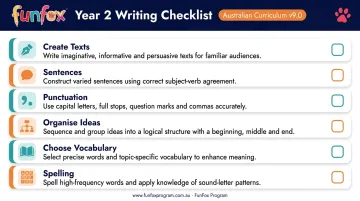
Under the Australian Curriculum v9.0, by the end of Year 2 students are expected to:
- Create texts across imaginative, informative, and persuasive purposes
- Write simple and compound sentences, connecting ideas with coordinating conjunctions
- Use basic punctuation — sentence boundaries, capital letters in titles, and commas in lists
- Organise and link ideas so a reader can follow the sequence of events or information
- Choose vocabulary suited to the topic they're writing about
- Spell most regular patterns, using phonic knowledge to attempt less familiar words
Formal paragraphing is not an explicit Year 2 requirement — that benchmark sits in Year 3 NAPLAN assessment. At Year 2, success looks like a child who can generate ideas, write them in connected sentences, and organise them so a reader can follow along. The priority is building confidence and the habit of putting thoughts into words.
Creative and Imaginative Writing Prompts for Year 2
Creative prompts work particularly well for reluctant writers because there are no wrong answers. The "what if?" mindset frees children from worrying about correctness — and the more outlandish the idea, the better.
Silly and Imaginative Story Starters
Open-ended and low-stakes, these prompts get pencils moving fast:
- "If my shoes could talk, they would say…"
- "One morning I woke up and everything was upside down…"
- "My pencil came to life and it wanted to…"
- "A spaceship landed in our backyard and inside was…"
- "If I could invent a brand-new holiday, it would be called…"
- "One day gravity stopped working and I had to…"
- "My shadow started doing things I didn't tell it to do…"
Animal-Themed Writing Prompts
Most Year 2 children are passionate about animals. These prompts tap into that enthusiasm and turn it into writing fuel:
- "If I could be any animal for a day, I would choose… because…"
- "Write a story about a lost puppy who needs to find their way home"
- "Imagine an animal moved into your house — what would happen?"
- "Write a diary entry from the point of view of a zoo animal"
- "If animals could talk, what do you think they would say to people?"
- "A baby dragon hatched in the school playground…"
Fantasy and Adventure Prompts
These prompts push children toward more structured storytelling — introducing characters, settings, and problems that need solving:
- "I found a magical door in the back of my wardrobe…"
- "A mysterious map appeared on my desk — it led to…"
- "You discover a secret world hidden under the school oval…"
- "You have been given a magic wand for one day — what do you do?"
- "Write about an adventure you go on with your best friend and a talking animal"
- "A letter arrived addressed to you, but the sender was from 200 years ago…"
Narrative, Opinion, and Journal Writing Prompts for Year 2
These three categories cover the text types Year 2 students practise in Australian classrooms — mixing them at home builds confidence across every writing purpose.
Personal Narrative and Journal Prompts
Personal experience is the easiest entry point for young writers. These prompts help children sequence real events and link them to emotions:
- "Write about a time you felt really proud of yourself"
- "Describe your perfect Saturday from morning to night"
- "Write about a time you helped someone — how did it make you feel?"
- "What is your favourite family tradition and why is it special?"
- "Describe the best birthday you've ever had"
- "Write about a time something scared you and how you felt better"
Opinion Writing Prompts
At Year 2, children start stating a position and backing it up with reasons — a skill that feeds directly into NAPLAN persuasive writing in Year 3. These prompts make that practice feel natural:
- "What is the best pet to have and why?"
- "Should kids have homework? Give your reasons"
- "What is the best sport to play — and why should everyone try it?"
- "Is it better to play inside or outside? Explain your thinking"
- "What one rule would you change at school and why?"
How-To and Informative Writing Prompts
How-to writing builds two skills at once: logical sequencing and writing for an audience. These prompts give children a clear purpose — explain it well enough that someone else could actually follow the steps:
- "How to make your favourite breakfast — explain each step"
- "How to look after a pet"
- "How to be a good friend — give three tips"
- "How to build the best sandcastle"
- "Explain how to play your favourite game for someone who's never tried it"
Fun Writing Activities to Try at Home
Sometimes the best writing doesn't start at a desk. These activities make the process feel more like play — which is often what gets reluctant writers moving.
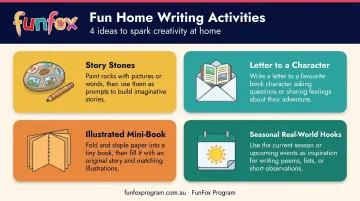
Activity 1: Story Stones
Paint simple pictures on smooth rocks (a castle, a dog, a tree, a star). Once they're dry, pick three at random and write a story that connects all three images. Children love the randomness of it, and the visual prompts remove the blank-page problem entirely.
Activity 2: Letter to a Fictional Character
Choose a character from a book your child loves. Write them a letter — ask questions, give them advice, or tell them what you think they should do next. It works so well because children already care about the character — the motivation is built in.
Activity 3: Illustrated Mini-Book
Fold four pieces of paper together to make an eight-page booklet. Your child writes a short story and draws the illustrations. Staple the spine. The moment it looks like a real book, motivation goes through the roof — and NSW Education's home literacy guidance specifically recommends creating storybooks with pictures and written words as a home activity.
Seasonal and Real-World Hooks
Keep writing connected to real life by using:
- A recount of a weekend outing or holiday trip
- Observations from a nature walk ("three things I noticed")
- A review of a film or book they just finished
- A note or letter to a relative about something that happened this week
Real-life hooks give children a genuine reason to write — and a real audience to write for.
Using Oral Storytelling as a Stepping Stone
If your child freezes when asked to write, try this first: ask them to tell you the story out loud. Once they've talked it through, help them write down what they said. This separates the creative thinking from the physical writing task, which is especially useful for children who find handwriting laborious. Programs like FunFox's Foundation Club use this exact approach — building verbal confidence before moving children into structured written work, so no child stalls at the blank page.
Tips for Using Writing Prompts With Your Year 2 Child
A few practical approaches make a real difference in how children respond to home writing practice.
Keep it low-pressure. Accept imperfect spelling without immediately correcting it. On a hard day, one strong sentence is a genuine win. Praise the ideas — the imagination, the detail, the choice of words — rather than the neatness or length.
Ask questions instead of correcting. When your child finishes a sentence or a paragraph, try:
- "What happened next?"
- "How did your character feel?"
- "Can you add one more detail about what it looked like?"
These gentle prompts extend thinking without making children feel like they've done something wrong.
Build a consistent routine. Even five to ten minutes of daily writing builds stamina steadily over a term. The Australian Curriculum emphasises regular writing practice — and consistency matters far more than duration. Short and regular beats long and occasional every time.
Let them choose their prompt. When children pick the topic themselves, engagement goes up noticeably. Keep a list of prompts visible and let them point to the one that excites them most.
For families who want structured support beyond home prompts, FunFox's Writers Club runs live online sessions in small groups of up to six students. It's aligned with the Australian Curriculum and targets the writing skills Year 2 students are expected to develop, with personalised teacher feedback provided between classes through Seesaw.
Frequently Asked Questions
What should a Year 2 child be able to write in Australia?
Under the Australian Curriculum v9.0, Year 2 students are expected to create imaginative, informative, and persuasive texts using simple and compound sentences, basic punctuation, and logical organisation of ideas. They should be selecting topic-appropriate vocabulary and spelling most common patterns correctly.
How long should a Year 2 student write each day?
Five to ten minutes of daily writing practice is a solid starting point at this age. NSW Education guidance recommends writing every day — consistency matters far more than duration, and short daily sessions build stamina much faster than one long weekly effort.
How do I get my Year 2 child interested in writing?
Let them choose prompts they find genuinely exciting, allow drawing alongside writing, and celebrate their ideas enthusiastically. Once writing feels fun rather than a test of correctness, most kids are far more willing to pick up the pencil.
What types of writing do Year 2 students learn?
The three main text types in the Australian Curriculum at Year 2 are imaginative (stories and narratives), informative (including how-to and explanatory writing), and persuasive (opinion) writing. All three are covered in the prompts throughout this post.
How can I help a reluctant Year 2 writer at home?
A few things tend to work well:
- Start with oral storytelling — let them tell the story aloud before writing it down
- Use highly engaging prompts (silly or animal-themed ones are great)
- Accept any length of response and keep sessions short
- End on a positive note every time
Are writing prompts useful for all Year 2 students, or just struggling writers?
Prompts benefit every young writer. For hesitant writers, they remove the blank-page barrier. For confident writers, they provide a launching pad for richer, more detailed stories — the boundaries of the prompt often push stronger writers to explore ideas they wouldn't have chosen themselves.