Introduction
Many children have vivid ideas and stories bursting to get onto the page — but when they sit down to write, the result doesn't match what they had in mind. Often, the gap isn't imagination. It's grammar and sentence structure.
This matters more than many parents realise. Research using data from 819 Australian primary school students found that spelling, grammar, and punctuation jointly predict written composition achievement — meaning children who struggle with these foundations tend to produce weaker written work overall, regardless of how creative their thinking is.
NAPLAN writing assessments directly measure sentence structure and punctuation as separate scored criteria. Yet grammar instruction at home is often inconsistent or reactive: addressed only when a teacher marks something wrong, rather than through planned, progressive skill-building.
This guide covers everything parents need to help their child build stronger grammar at home, grounded in the Australian Curriculum:
- The core building blocks of grammar and sentence structure
- The most common errors primary school children make
- A practical five-step approach to improvement
- Daily activities to reinforce skills at home
Key Takeaways
- Every sentence needs a subject and a verb — that's the non-negotiable starting point
- Four sentence types (simple, compound, complex, compound-complex) give children the tools for varied, engaging writing
- Five patterns account for most grammar errors in children's writing: fragments, run-ons, agreement errors, punctuation mistakes, and unclear pronoun references
- Short, regular practice builds lasting grammar skills more effectively than occasional long sessions
- Specific, constructive feedback accelerates improvement more than vague correction
What Are the Building Blocks of Good Grammar and Sentence Structure?
Before a child can fix their grammar, they need to understand what a sentence actually is. At its simplest: a sentence is a complete thought with at least a subject (who or what it's about) and a verb (what they do or are). "The cat slept" is a sentence. "Because the cat" is not.
Clauses: The Core Unit of Every Sentence
A clause is a group of words containing a subject and a verb. The Australian Curriculum defines clauses precisely this way, and recognising the difference between clause types is what allows students to build more varied, controlled sentences.
Two types matter most:
- Independent clause — can stand alone as a complete sentence. "The dog ran fast."
- Dependent clause — has a subject and verb but cannot stand alone; it depends on an independent clause to make sense. "Because it was excited."
The Four Sentence Types Primary Students Should Know
The Australian Curriculum v9 introduces these structures progressively across Years 1–4:
| Sentence Type | Structure | Example |
|---|---|---|
| Simple | One independent clause | The dog ran fast. |
| Compound | Two independent clauses + coordinating conjunction | The dog ran fast, and it caught the ball. |
| Complex | One independent + one dependent clause | The dog ran fast because it was excited. |
| Compound-complex | Two independent + at least one dependent clause | The dog ran fast because it was excited, and it brought the ball back. |
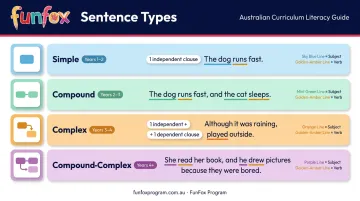
Compound-complex sentences aren't formally named in the Australian Curriculum until upper primary, making them an extension goal for Years 5–6.
Knowing where a child sits in that progression matters for NAPLAN preparation too. NAPLAN's Sentence Structure criterion assesses whether writing contains "grammatically correct, structurally sound and meaningful sentences." Writing that relies entirely on simple sentences reads as flat and immature. Examiners pick up on this quickly. A child who can deliberately vary sentence types writes more engagingly and scores higher.
Common Grammar and Sentence Structure Mistakes Primary School Students Make
Most grammar errors in children's writing follow a small number of recurring patterns. Identifying which pattern a child tends toward makes correction far more targeted and effective.
Sentence Fragments
A fragment is an incomplete sentence — it's missing a subject, a verb, or both. Dependent clauses left on their own are a common culprit.
- Fragment: Because she was tired.
- Complete sentence: She went to bed early because she was tired.
Teach children to self-check by asking: "Does this sentence have a who and a what they did?" If either is missing, it's a fragment.
Run-On Sentences
Run-ons happen when two or more independent clauses are joined without proper punctuation or connecting words. Two main forms:
- Fused sentence (no punctuation): The dog ran it caught the ball.
- Comma splice (comma only, no conjunction): The dog ran, it caught the ball.
Correction strategies:
- Split into two separate sentences
- Add a coordinating conjunction (and, but, so)
- Use a subordinating conjunction to create a complex sentence
NAPLAN marking guides note that overuse of "and" or "so" to chain clauses together — rather than using full stops — is treated as a run-on error.
Subject-Verb Agreement Errors
The verb must match its subject in number. Errors most often creep in when a long phrase separates the subject from the verb.
- Error: The box of apples are on the table.
- Correct: The box of apples is on the table.
A reliable trick: strip the sentence back to just subject + verb. "The box is" — yes. "The box are" — no.
Incorrect or Missing Punctuation
The most common punctuation errors in primary writing:
- Missing comma before a coordinating conjunction in a compound sentence
- Comma splices (see run-ons above)
- Using "and" repeatedly instead of a full stop
Punctuation isn't just cosmetic: a missing full stop or misplaced comma can change what a sentence means entirely. Connecting punctuation directly to meaning — rather than reciting rules — helps children understand why it matters.
Unclear Pronoun Reference
This happens when "it," "they," or "this" doesn't clearly point back to a specific noun.
- Unclear: Sam told Jake he had won the prize.
- Clear: Sam told Jake that Jake had won the prize.
When a child rereads their writing and can't immediately tell what a pronoun refers to, the fix is simple: name the noun again.
How to Improve Grammar and Sentence Structure: A Step-by-Step Approach
Grammar improvement isn't a one-time lesson. It's built through layered, consistent practice — and the steps below work best when introduced in order and revisited regularly.
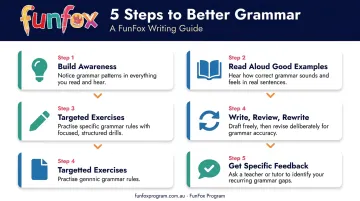
Step 1: Build Awareness of the Key Rules
Comprehension comes before application. Before practising correction, make sure the child understands what the grammar concept actually is — what a sentence fragment means, why subject-verb agreement matters. Use simple definitions and visual examples (colour-coding subjects in one colour, verbs in another works well for visual learners).
Step 2: Read Examples of Good Sentences Aloud
Reading well-written sentences aloud helps children internalise what correct grammar sounds like — not just what it looks like on a page. Research on print exposure shows that text exposure predicts spoken production of complex sentences in 8- and 12-year-olds, suggesting that children who read widely naturally develop stronger syntactic instincts.
A practical approach: read a short passage together, then ask the child to identify the subject and verb in two or three sentences. Ask how the author used punctuation, or which sentence type they used.
Step 3: Practise Targeted Grammar Exercises
Focus on one grammar concept at a time — fixing run-on sentences this week, subject-verb agreement next week. The most effective exercise types ask children to:
- Identify errors in a given sentence
- Correct those errors by rewriting
- Combine two short sentences into one more complex sentence
The Education Endowment Foundation recommends that students practise sentence combining and construction techniques to produce varied and more complex sentences — and research supports this approach specifically for primary-aged writers.
FunFox's Writers Club is built around exactly this model — structured writing exercises delivered in small-group live sessions, with teachers guiding children through sentence combining and construction across Years 2–6 and providing personalised feedback via Seesaw.
Step 4: Write, Review, and Rewrite
Ask the child to write a short piece — a paragraph, a story opening — then review it specifically for the grammar concept being practised. The revision step is where the real learning happens, not the initial draft.
Teach children to ask while reviewing:
- Does every sentence have a subject and a verb?
- Are my sentences connected correctly?
- Have I used a variety of sentence types?
Step 5: Get Specific, Constructive Feedback
There's a meaningful difference between unhelpful feedback ("This is wrong") and feedback that actually teaches ("This sentence is a fragment because it has no verb — can you add one?"). Specific feedback gives children a repair strategy, not just a red mark.
Parents can absolutely provide this at home. The key is naming the error type and asking the child to fix it themselves — rather than fixing it for them.
Practical Daily Activities to Reinforce Grammar Skills at Home
Consistency matters more than intensity. Short, regular grammar activities produce better long-term retention than occasional long sessions — a principle supported by research on spaced learning. Fifteen minutes three times a week beats an hour once a fortnight.
Sentence Sorting and Building Games
Give children word cards or cut-up sentences and ask them to:
- Arrange the words into a correct sentence
- Identify whether a sentence strip is a fragment or a complete sentence
- Combine two short sentences into one compound or complex sentence
It works well for visual and kinaesthetic learners and needs only paper, scissors, and a pen.
Read and Spot the Error
Write out a short paragraph with three or four deliberate grammar errors — a sentence fragment, a comma splice, a subject-verb agreement mistake — and ask the child to find and fix them.
This builds error recognition and understanding of why the correction is needed. It's a more durable skill than simply memorising a rule, because the child has to reason through the problem.
Good error types to include are:
- Sentence fragments (missing a subject or verb)
- Comma splices (two independent clauses joined by a comma alone)
- Subject-verb disagreement ("The dogs was barking")
Journaling with a Grammar Focus
Each week, give the writing journal a single grammar focus: "This week, write five sentences using compound sentences." Or "Today, make sure every pronoun clearly refers back to its noun."
Reviewing journal entries after a few weeks lets children see their own progress — and that visible improvement is one of the most effective ways to keep motivation going.
Conclusion
Improving grammar and sentence structure means building a child's ability to express ideas clearly and precisely — not just drilling rules, but developing foundational skills they can actually use.
The biggest gains come from understanding key concepts, practising consistently at a targeted level, and receiving specific feedback that tells a child what to fix and how. Parents play a more powerful role in this process than they often realise. The activities in this guide are achievable at home with minimal preparation.
For families who want structured, curriculum-aligned support, FunFox's online Writers Club offers weekly live sessions specifically designed for Australian primary school students in Years 2–6, combining small-group instruction (maximum six students) with personalised written feedback each term to build grammar confidence in line with the Australian curriculum.
Frequently Asked Questions
What are the 7 basic sentence structures?
The commonly referenced seven structures span two classification systems. The first covers grammatical construction: simple, compound, complex, and compound-complex. The second covers communicative purpose: declarative, interrogative, imperative, and exclamatory. Primary school students typically learn the four structural types first, with sentence purpose introduced alongside them.
What is the difference between grammar and sentence structure?
Grammar is the broader set of rules governing language — tenses, parts of speech, punctuation, and more. Sentence structure refers specifically to how words and clauses are arranged to form a complete, clear sentence. The two overlap constantly: sentence structure is one important part of the larger grammar system.
At what age should children start learning sentence structure?
Children naturally form simple sentences in early speech, but formal teaching begins in Year 1 of primary school. The Australian Curriculum introduces compound sentences in Year 2, clauses and subject-verb agreement in Year 3, and complex sentences in Year 4. More advanced structures continue through upper primary.
How can I help my child improve their grammar at home?
A few consistent habits make a real difference:
- Read aloud together and discuss how sentences are built
- Practise one grammar concept at a time with short, targeted exercises
- Encourage regular writing with a specific grammar focus each session
- Give feedback that names the error type and asks your child to correct it themselves
What are the most common grammar mistakes primary school students make?
In Australian primary writing assessments, the most common error categories are:
- Sentence fragments and run-on sentences (including repeated "and" chaining)
- Subject-verb agreement errors
- Punctuation mistakes such as comma splices and missing full stops
- Unclear pronoun references
How long does it take to improve grammar skills in children?
Timelines vary by age, starting skill level, and how consistently practice happens. Research on structured sentence-combining programs shows measurable sentence-level gains after 8–10 weeks of targeted work. Most children show noticeable progress within a school term when errors are identified specifically and addressed through regular, focused practice.