Introduction
Year 3 marks a genuine turning point in your child's reading journey. Up until now, the focus has been on cracking the code — sounding out words, building fluency, recognising sight words. From Year 3 onwards, Australian children (ages 8–9) are expected to do something harder: read to understand, analyse, and think.
That shift puts comprehension front and centre. And for many parents, it raises a practical question — what should home practice actually look like?
This guide covers what Year 3 comprehension looks like under the Australian Curriculum v9.0, which skills worksheets should target, how to choose quality resources, and how to make home practice count. It also addresses when worksheets alone aren't enough.
Key Takeaways:
- Year 3 comprehension covers inference and text analysis, not just recall
- Quality worksheets should cover both fiction and non-fiction texts
- Short, consistent practice sessions outperform occasional marathon efforts
- A before, during, and after reading routine builds real comprehension skills
- When comprehension gaps persist, live, guided support makes a meaningful difference
What Year 3 Reading Comprehension Looks Like Under the Australian Curriculum
The Australian Curriculum v9.0 for Year 3 English sets out clear expectations that move well beyond word recognition. By the end of Year 3, students are expected to:
- Identify the audience and purpose of imaginative, informative, and persuasive texts (AC9E3LY03)
- Read a range of texts using phonic, semantic, and grammatical knowledge — re-reading and self-correcting as needed (AC9E3LY04)
- Use comprehension strategies to build both literal and inferred meaning, and begin evaluating texts (AC9E3LY05)
The achievement standard is specific: students should "identify literal meaning and explain inferred meaning," describe how texts are structured, and engage with vocabulary including topic-specific terms and literary devices. That last point — inferred meaning — is where Year 3 marks a genuine shift.
The Literal vs. Inferential Distinction
Literal comprehension means finding information stated directly in the text: the who, what, where. Inferential comprehension means reading between the lines — working out a character's feelings from their actions, understanding why something happened, or predicting what comes next.
Year 3 is where inferential comprehension begins to be formally developed, not just incidentally practised. A good worksheet needs to target both levels deliberately, not treat inference as a bonus question.
Text Type Matters Too
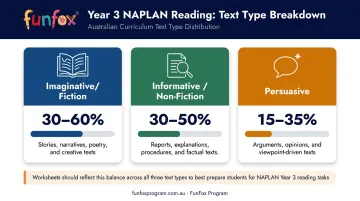
Year 3 students are expected to work with imaginative (fiction), informative (non-fiction), and persuasive texts. The NAPLAN assessment framework reflects this directly — Year 3 reading assessments target 30–60% imaginative texts, 30–50% informative texts, and 15–35% persuasive texts. Worksheets that only use stories are leaving significant ground uncovered.
Variation in readiness is completely normal. Some Year 3 children arrive as confident, fluent readers; others are still consolidating decoding. Worksheets can and should be chosen to meet a child where they are.
Key Comprehension Skills Year 3 Worksheets Should Target
Good worksheets don't just test reading — they build it. The NSW Department of Education's Stage 2 guidance identifies five skill areas that directly map to what Year 3 students need to practise.
Literal Retrieval
Retrieval tasks ask children to locate facts or details explicitly stated in the text. These are typically the entry-level questions on any Year 3 worksheet, and that's appropriate — they build confidence and accuracy before moving to inference and analysis. Scanning skills (running their eyes quickly over a text to find specific information) are a key part of this.
Inference and Prediction
Inference at Year 3 means using clues in the text, combined with what the child already knows, to work out something the author hasn't stated outright — a character's mood, a reason behind an action, or an implied consequence.
Prediction is a natural bridge into inference. Asking "what do you think will happen, and why?" encourages children to use evidence from the text rather than guessing freely. Fiction-based worksheets are particularly well-suited to this.
Vocabulary in Context
Vocabulary in context means working out the meaning of an unfamiliar word from the surrounding sentences — using clues like contrast, example, or explanation within the text. This builds vocabulary and comprehension together, without needing to pause and look anything up.
Identifying Main Idea and Text Structure
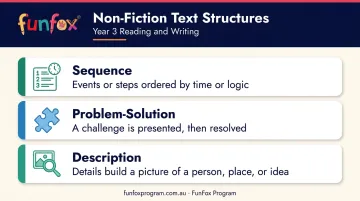
Naming the main idea of a paragraph — as distinct from a supporting detail — is genuinely challenging for most 8-year-olds. Worksheets that ask children to write a one-sentence summary, choose the best title, or identify a text's structure help develop this skill deliberately. Common structures to recognise include:
- Sequence — events or steps ordered by time or logic
- Problem-solution — a challenge is presented, then resolved
- Description — details build a picture of a person, place, or idea
Types of Year 3 Reading Comprehension Worksheets
Fiction Comprehension Passages
Fiction worksheets are built around short stories or narrative extracts — typically 150–300 words for Year 3. The best ones include a mix of question types: some literal retrieval, some inference, and at least one vocabulary question. Questions that ask children to respond to a character's emotions or predict a plot outcome push thinking beyond surface recall.
Non-Fiction and Informational Text Worksheets
Non-fiction comprehension works differently from fiction. Children need to navigate headings, captions, bold terms, and sometimes diagrams to locate information — a genuinely separate skill from literary reading.
PIRLS 2021 data for Australia treats literary and informational reading as equally weighted, separate competencies — each makes up 50% of the international assessment. Informational reading isn't an add-on; it's half the picture.
Look for non-fiction worksheets on topics children actually find interesting: animals, how things work, sport, science, history. Children who care about the topic read more carefully and retain more of what they read.
Cloze Exercises and Sentence Completion
Cloze worksheets (fill-in-the-blank passages) are useful for building contextual reading and vocabulary. Quality matters: the missing words should be ones children can logically infer from surrounding context, not blanks that could accept almost any word.
Graphic Organiser Worksheets
Story maps, character webs, main idea/details charts, and cause-and-effect diagrams give children a visual scaffold to organise thinking before writing any answers. These work especially well for children who struggle to structure responses — the visual framework handles the sorting, freeing the child to focus on comprehension itself.
How to Choose Quality Year 3 Reading Comprehension Worksheets
Not all worksheets are created equal. Here's what to look for:
Markers of a well-designed worksheet:
- Text at an appropriate reading level — challenging enough to develop comprehension, not so hard that decoding becomes the obstacle
- A mix of question types (not just true/false or single-word answers)
- Questions that require the child to return to the text, not just answer from memory
- Both fiction and non-fiction texts represented across a worksheet set
Once you've found worksheets that tick those boxes, it's worth checking where they come from. Parents downloading free resources from US or UK sites should verify curriculum and age alignment. Australian Year 3 (ages 8–9) aligns roughly with Year 4 in England or Grade 3 in the US — but curriculum expectations differ meaningfully across these systems. Resources built for the Australian Curriculum are a safer starting point.
Topic selection matters more than parents realise. A well-structured worksheet on a boring topic will produce less genuine comprehension development than a simpler one on something the child is curious about. Rotate topics over time — animals, adventure, sport, space, Australian history — to keep engagement high and text-type variety broad.
How to Use Worksheets Effectively at Home
Keep Sessions Short and Consistent
Reading researchers consistently recommend short daily reading as the most effective literacy habit — and the same logic applies to worksheets. For comprehension practice specifically, 10–15 minutes three to four times per week is far more sustainable than one long session on the weekend. Short, regular sessions help Year 3 students build the stamina and recall that comprehension depends on.
Use the Before, During, After Habit
This simple routine works alongside any worksheet:
- Before reading — ask your child to predict what the passage might be about based on the title or any images
- During reading — pause once partway through to check understanding: "What's happened so far?"
- After reading — discuss what they found interesting or confusing before they attempt any written answers
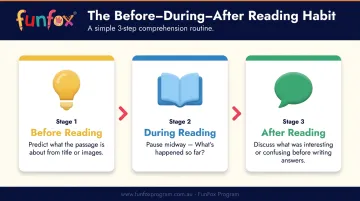
The discussion step is often skipped, but it's where a lot of the comprehension actually develops.
Turn Answers into Conversations
When your child writes an answer, ask them to show you where in the text they found it. This one habit — pointing to the evidence — trains exactly the kind of thinking that carries students through primary school and beyond. You can tell a lot from that moment: whether they understood the question, made an educated guess, or genuinely retrieved information from the passage.
Through all of this, keep the tone low-pressure. Worksheet time works best when it feels like a conversation, not a test.
When Worksheets Aren't Enough
Worksheets are a genuinely useful tool. But they have real limits: they can't adapt to a child's reasoning in the moment, ask follow-up questions, or spark the kind of text discussion that deepens comprehension over time.
Signs a child may need more than home practice:
- Consistently skipping questions, especially inference ones
- Writing answers that don't relate to what the text actually says
- Strong fluent reading, but poor recall immediately after
- Growing reluctance or frustration around reading activities
- Comprehension that doesn't seem to improve despite regular practice
For children showing these patterns, structured support from a trained teacher can make a real difference — especially when they receive real-time feedback on their thinking, not just a marked worksheet returned the next day.
FunFox's Readers Club addresses this gap directly. It's a live, small-group online program for Years 3–6 students, with qualified teachers guiding comprehension strategies, critical thinking, and literary analysis in weekly one-hour sessions — groups capped at six children.
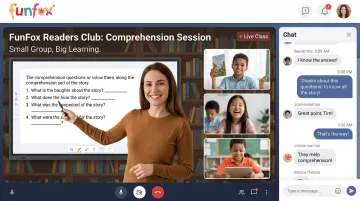
Students complete interactive digital worksheets before each session, so class time goes toward discussion, guided analysis, and peer activities rather than solo tasks. The program is aligned to Australian Curriculum expectations throughout.
Parents can trial the program through a free trial class before enrolling for a term.
Frequently Asked Questions
What comprehension skills should a Year 3 student have in Australia?
Under the Australian Curriculum v9.0, Year 3 students are expected to retrieve directly stated information, make basic inferences, identify main ideas, understand vocabulary in context, and engage with both fiction and non-fiction texts. The achievement standard explicitly requires students to "identify literal meaning and explain inferred meaning."
How long should Year 3 reading comprehension worksheets be?
Passages for Year 3 should typically be 150–300 words, with 5–8 questions covering a mix of question types. That length is short enough to hold focus but long enough to build genuine reading stamina.
What's the difference between Year 3 comprehension in Australia vs. the UK or US?
Australian Year 3 children are around age 8. This aligns roughly with Year 4 in England (ages 8–9) and Grade 3 in the US (also ages 8–9), but curriculum expectations differ. Always check age and curriculum alignment when downloading free worksheets from international websites.
How often should my Year 3 child practise reading comprehension at home?
Short, regular sessions work best — 10–15 minutes, three to four times per week. Consistency matters more than duration. Infrequent longer sessions are less effective at building the reading habit.
What should I do if my Year 3 child finds comprehension worksheets too hard?
Start by checking whether the text level suits your child's current reading ability — a mismatch is the most common cause. Try reading the passage aloud together first, then have your child attempt the questions. If difficulties persist, consider structured support from a trained teacher, such as FunFox's Readers Club, which offers small-group comprehension sessions aligned to the Australian Curriculum.
Are online reading comprehension resources as useful as printed worksheets for Year 3?
Both work well when thoughtfully designed. Online resources offer immediate feedback and varied formats, while printed worksheets build the focus and handwriting skills needed for school assessments. For most families, a mix of both is the most practical approach.