Introduction
Your child reads the words on the page without hesitation. Then you ask, "So what happened in the story?" — and you get a blank stare.
This gap between word recognition and actual understanding is one of the most common frustrations parents experience in Year 1. Reading comprehension is a separate skill from decoding — and like any skill, it needs deliberate, consistent practice to develop.
That's exactly what this guide is for. It covers what Year 1 reading comprehension looks like under the Australian Curriculum, which skills children develop at ages 5–6, and how to choose worksheets that genuinely build understanding — not just fill time.
Key Takeaways
- Year 1 comprehension spans fiction, poetry, and non-fiction across both listening and independent reading
- Core skills at this stage include retrieval, prediction, vocabulary, basic inference, and retelling
- Good worksheets use age-appropriate texts, mixed question types, and scaffolded response formats
- Pair worksheets with daily read-alouds and open-ended discussions for the strongest results
What Is Year 1 Reading Comprehension? (Australian Curriculum Context)
Reading comprehension is the ability to understand, interpret, and respond to what is read — and it's distinct from phonics and decoding, even though children need both to read successfully. The Australian Curriculum v9.0 English strand separates Language and Literacy from Literature, and both inform Year 1 comprehension expectations.
What Year 1 Children Are Expected to Do
Under the Australian Curriculum, Year 1 students (ages 5–6) are expected to:
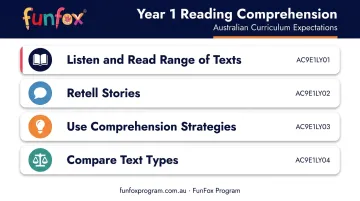
- Listen to and read a range of imaginative, informative, and persuasive texts — including picture books, poetry, stories, and non-fiction
- Retell familiar stories using plot, characters, and familiar text structure (AC9E1LE05)
- Use comprehension strategies including visualising, predicting, connecting, summarising, and questioning to build literal and inferred meaning (AC9E1LY05)
- Begin describing similarities and differences between text types (AC9E1LY03)
The Year 1 Transition
One of the big shifts in Year 1 is that children move from primarily listening comprehension — understanding what someone reads to them — toward answering questions about texts they read themselves. This transition feels uneven for many children, and unevenness at this stage is expected.
Australian longitudinal research by Zubrick et al. found that low literacy at age 4–6 is the strongest predictor of low literacy at age 10. That's why the comprehension foundations built in Year 1 matter well beyond any single school assessment.
Comprehension vs. Decoding: Why Both Matter
The Simple View of Reading — a framework used by Literacy Hub in Australia's Year 1 Phonics Check guidance — describes reading as: Decoding × Language Comprehension = Reading Comprehension.
A child who decodes every word perfectly but can't make meaning has half the skill. A child who understands language well but can't yet decode faces the same ceiling. Year 1 is where both tracks need to run in parallel.
Key Reading Comprehension Skills Year 1 Children Develop
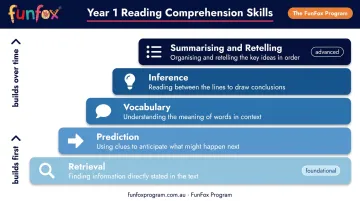
Comprehension isn't one skill — it's a cluster of building blocks that develop at different rates. Knowing which ones to look for helps you choose the right worksheets and ask the right questions at home.
Retrieval
Retrieval means finding information that's directly stated in the text: Who was in the story? Where did it happen? What did the character do?
This is the most accessible comprehension skill for 5–6 year olds and the foundation everything else builds on. It's usually the first question type on Year 1 worksheets — children can practise answering questions before they need to interpret or infer anything.
Prediction
Prediction involves using clues from the text and illustrations to anticipate what happens next. It teaches children to read actively — engaging with the text rather than just decoding words in sequence.
At Year 1 level, prediction is often introduced orally ("What do you think will happen?") before children write responses.
Basic Inference
Inference — reading between the lines — is introduced at a simple level in Year 1. A child might work out that a character is scared based on what they said or did, even if the word "scared" never appears.
This is one of the harder skills for children this age. Research confirms that inferential comprehension begins developing from age 3–6, but it builds gradually and takes time to develop.
Vocabulary and Word Meaning
Year 1 comprehension also involves understanding unfamiliar words in context. A worksheet might ask children to circle a word that means "happy," or match words to pictures.
Vocabulary grows fast at this age — but a single unfamiliar word can still derail understanding of an entire passage. Common worksheet tasks include:
- Circling synonyms or antonyms in a sentence
- Matching words to their picture definitions
- Using context clues to guess a word's meaning
Summarising and Retelling
Retelling a story in sequence — beginning, middle, end — is a core Year 1 skill. Worksheets often use cut-and-sequence activities, picture ordering, or sentence starters to scaffold this skill.
Encouraging children to retell stories out loud before writing them down makes both versions stronger — the spoken practice builds the mental structure that the written version then follows.
What Makes a Good Year 1 Reading Comprehension Worksheet?
Not all worksheets are equally useful. Here's what to look for when evaluating resources for home use.
Age-Appropriate Text Complexity
The passage should sit at or just above your child's independent reading level — challenging enough to stretch understanding, but not so difficult that frustration takes over.
What appropriate Year 1 texts look like:
- Short paragraphs or a few clear sentences
- Familiar themes (animals, family, school, nature)
- Clear illustrations that support meaning
- Mostly accessible vocabulary with 1–2 new words to explore
The Australian Curriculum notes that Year 1 informative texts should "present a small amount of new content about familiar topics" and include illustrations or diagrams. Narrative texts should have "straightforward sequences of events."
A Mix of Question Types
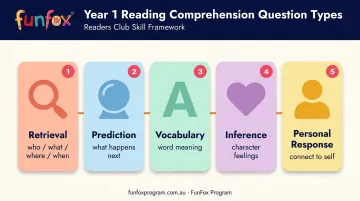
A strong Year 1 worksheet includes variety across question types, not just one category. Look for:
- Retrieval questions that cover who, what, where, and when
- Prediction prompts asking what might happen next
- Vocabulary questions exploring word meaning and how language conveys feeling
- Simple inference questions asking how a character felt and how the reader knows
- Personal response prompts connecting the text to the child's own experience
Variety matters because each question type targets a different reading skill — and children need practice across all of them to become confident, flexible readers.
Scaffolded Response Formats
Year 1 children are still developing their writing. Good worksheets use a mix of:
- Tick boxes or circle-the-answer
- Draw and label
- Sentence completion with a starter phrase
- Short written responses (1–2 sentences, with lined support)
Worksheets that expect extended written answers can frustrate children whose writing lags behind their comprehension ability — and that frustration is about the writing, not the understanding.
Both Fiction and Non-Fiction Texts
Quality Year 1 worksheets cover both narrative and informational texts. The Australian Curriculum requires engagement with both, and non-fiction comprehension is a different set of skills from fiction reading.
Non-fiction reading asks children to:
- Read for specific facts rather than following a story
- Understand diagrams, labels, and captions alongside text
- Identify the topic sentence and main idea of a passage
- Distinguish between what a text states and what they already knew
Worksheets that include both text types give children the range they need — fiction builds imagination and inference, while non-fiction builds the analytical habits that carry across every subject.
How to Use Reading Comprehension Worksheets Effectively at Home
Handing a child a worksheet and walking away rarely works at Year 1. The most effective approach involves a brief warm-up, supported completion, and a short discussion afterwards.
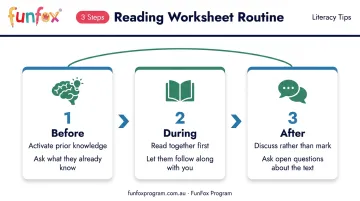
Before the Worksheet: Activate Prior Knowledge
Spend 2–3 minutes before reading:
- Read the title together and look at any pictures
- Ask: "What do you think this might be about?"
- Make a quick prediction out loud
This mirrors what teachers do in the classroom and primes the child's brain to connect new information to what they already know.
During: Read Together First, Then Answer
Read the passage aloud with your child — or to them — before expecting independent answers. When a child's mental energy is consumed by decoding, there's little left for comprehension.
Sharing the reading burden means your child can focus on meaning. You can gradually hand more of the reading back to them as their fluency builds.
After: Discuss Rather Than Mark
After the worksheet, have a conversation about the answers rather than simply marking right or wrong. Ask:
- "How did you work that out?"
- "What in the story made you think that?"
- "Did anything surprise you?"
This builds metacognitive habits — helping children become aware of how they're thinking, not just what they answered. Australian education authorities, including the NSW Department of Education, specifically recommend this type of reflective questioning as a way to deepen comprehension — not just check answers.
Common Challenges in Year 1 Reading Comprehension (and How to Help)
Most challenges at this stage are normal and addressable. Here are the three parents encounter most.
"They Can Read the Words But Don't Know What Happened"
This is the decoding-comprehension mismatch. When phonics effort is high, comprehension suffers — the brain is occupied sounding out words, leaving little room to process what the story actually means.
What helps: Read the text aloud yourself so your child can focus entirely on understanding. Gradually transfer reading responsibility back to them as their fluency improves. The goal is to separate the two skills temporarily, not eliminate the challenge altogether.
Limited Vocabulary Blocking Understanding
Fluency alone won't carry a child through a passage if key words are unfamiliar. One unknown word can derail the whole thing for a 5–6 year old.
What helps:
- Pre-teach 1–2 key words before reading begins
- Use pictures and context to build meaning, not just definitions
- Keep a simple vocabulary notebook or "word wall" to revisit new words across multiple sessions
Short Attention Span and Reluctance
Ten to fifteen minutes is typically the limit for focused comprehension work at this age. Pushing beyond that rarely produces learning. More often, it produces resistance.
What helps:
- Choose topics connected to your child's interests (animals, sport, space, favourite characters)
- Use illustrated texts where possible
- Celebrate effort and curiosity, not just correct answers — children who enjoy reading at this age tend to keep reading as they get older
Beyond Worksheets: Building a Complete Year 1 Reading Routine
Worksheets are one useful tool, but comprehension grows most when children are reading widely, hearing stories read aloud, and having rich conversations about books each day.
A simple daily reading routine for Year 1:
- Daily: 10–15 minutes of shared or independent reading, with open-ended discussion about what was read
- 2–3 times per week: Worksheet practice (not daily — quality and engagement matter more than frequency)
- Ongoing: Rereading favourites, visiting the library, talking about books casually
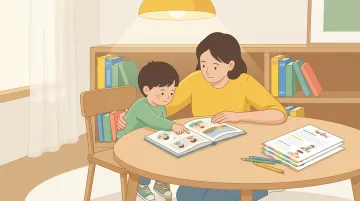
The Raising Children Network emphasises that making reading and storytelling part of daily family life is one of the most powerful things parents can do for early literacy.
FunFox's Foundation Club is built for Years 1–2 families who want more structured, teacher-led support. It's a hybrid live online program covering guided reading, comprehension, and writing — delivered in small groups of no more than six students and aligned to the Australian Curriculum.
Frequently Asked Questions
What reading comprehension skills should a Year 1 child have in Australia?
Under the Australian Curriculum, Year 1 children should be able to retell familiar stories, answer simple questions about texts they read and listen to, identify characters and settings, and begin making predictions and basic inferences. These skills are developed progressively across the year.
How do I know if my Year 1 child is struggling with reading comprehension?
Watch for these signs: reading words aloud fluently but being unable to retell the story, consistently saying "I don't know" to comprehension questions, forgetting what a short text was about shortly after reading it, or showing strong reluctance around reading activities.
How often should Year 1 children practise with reading comprehension worksheets?
Two to three short sessions per week (around 10–15 minutes each) is more effective than daily practice at this age. Pair worksheet sessions with daily read-alouds and conversation — engagement and quality matter more than frequency.
What is the difference between decoding and reading comprehension?
Decoding is the ability to sound out and recognise written words. Comprehension is the ability to understand what those words mean together. Year 1 is when children develop both skills in parallel — a child can decode every word on the page and still miss the meaning of what they've read.
What types of questions appear on Year 1 reading comprehension worksheets?
Common question types include retrieval (who, what, where, when), prediction, vocabulary and word meaning, character feelings or simple inference, and retelling or sequencing tasks. Worksheets that cover all five types reveal far more about a child's understanding than those focused on retrieval questions alone.
Are free reading comprehension worksheets for Year 1 reliable?
Quality varies. Evaluate free worksheets against the criteria in this guide: age-appropriate text, mixed question types, scaffolded response formats, and both fiction and non-fiction options. Prioritise resources that explicitly state alignment with the Australian Curriculum — a polished design or well-known website is no guarantee of educational value.