Introduction
You notice it gradually. Homework takes longer than it should. Your child's teacher mentions they're struggling to keep up. Or maybe confidence around reading and writing has dropped — they groan when it's time to read aloud, or their pencil barely moves when they sit down to write.
So you type "private tutors near me" into Google and get hundreds of results. The hard part isn't finding options. It's knowing which ones are actually worth your time and money.
This guide covers what to look for in a tutor, where to search, how much to expect to pay, what questions to ask before you commit — and why the best option for your child might not be down the street at all.
Key Takeaways
- NAPLAN data shows 1 in 10 Year 3 students need additional reading support — early action produces significantly better outcomes than waiting.
- Strong tutoring depends on teaching style, curriculum alignment, and progress communication — not just qualifications.
- Live, structured online sessions led by qualified teachers deliver results comparable to in-person tutoring.
- Shortlist two or three options and request a trial before committing to any program.
- Cost varies widely; weigh credentials, structure, and results alongside price.
Signs Your Child Could Benefit from a Private Tutor
Academic Warning Signs
Some signals are straightforward. Watch for:
- Slipping grades or work that's consistently below the class average
- Difficulty completing homework without significant parental help
- Teacher feedback about gaps in core skills — reading fluency, writing, comprehension
- NAPLAN results showing "Developing" or "Needs additional support" — in 2025, 10.8% of Year 3 students fell into that category for reading
Writing deserves separate attention. ACARA's 2024 data shows 67.3% of Year 5 students were at or above Strong in writing — which means nearly one in three weren't. A child who reads adequately can still be significantly behind in written expression — and that gap tends to widen through upper primary.
Emotional and Behavioural Signals
Not all signs show up in test scores. The Raising Children Network notes that children with learning difficulties often:
- Avoid or become upset during homework
- Resist reading aloud or refuse to write
- Express low confidence about schoolwork
- Start disliking school more generally
These responses are worth taking seriously. They often signal that a child needs more targeted support than a classroom of 25+ students can provide.
When Tutoring Helps Confident Learners Too
Tutoring isn't reserved for students who are falling behind. Children who are performing adequately but want to strengthen a specific skill — creative writing, reading comprehension, literary analysis — benefit just as much from focused, structured support. In a small group of four to six students, a capable child gets the kind of targeted feedback and challenge that simply isn't possible when a teacher is managing a full class.
What to Look for in a Private Tutor
Qualifications and Curriculum Fit
A background in education matters — a teaching degree or equivalent — but subject knowledge alone isn't enough. The tutor needs familiarity with the Australian curriculum and the specific year level your child is at. Someone who tutored senior students may not understand how to teach foundational phonics or early writing to a Year 2 child.
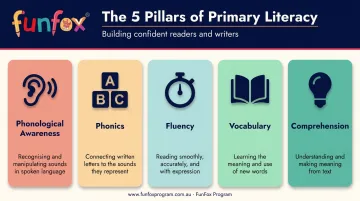
For primary literacy specifically, look for tutors or programs that address these key components:
- Phonological awareness
- Phonics
- Fluency
- Vocabulary
- Comprehension
Teaching Style and Session Structure
The best primary tutors are patient, adaptable, and genuinely engaging. A good session doesn't just repeat what the classroom already tried — it finds a different way in.
Look for:
- Sessions that identify a child's specific gaps rather than following a generic script
- Clear lesson plans with flexibility to adjust based on how the child responds
- An approach that makes content feel interesting, not like a chore
Communication with Parents
A quality tutor should be able to tell you — specifically — what they worked on, what progress was made, and what the next steps are. Vague reassurances aren't progress reporting. Watch out for these warning signs before committing:
- No references, reviews, or traceable teaching experience
- Can't explain their teaching methodology when asked
- No alignment with the school curriculum
- Pressure to commit before a trial session
In-Person vs. Online Tutoring: What Works Best for Primary School Students
The Case for In-Person
Face-to-face tutoring has genuine advantages for younger learners. Physical presence makes rapport easier to build, hands-on materials are simpler to share, and children in Year 1–2 who are still developing self-regulation often respond better to an adult in the room.
Key strengths of in-person tutoring include:
- Easier rapport-building for younger or more distracted children
- Hands-on materials (whiteboards, manipulatives, printed texts) without screen logistics
- Fewer technical barriers for families less comfortable with online tools
What the Research Says About Online
Online tutoring is viable — but not automatic. A randomised trial of virtual reading tutoring for Years 1–6 found a +0.12 effect size, equal to roughly 1.5 additional months of learning, rising to +0.17 for students who completed 40 or more sessions. More sessions produced stronger outcomes — the frequency effect was consistent across the data.
A separate K-2 virtual tutoring study found gains of 0.05 to 0.08 standard deviations — positive, though smaller than typical in-person early literacy programs. Online tutoring can work well, but the conditions matter.
What Makes Online Work
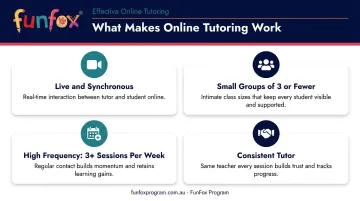
High-impact tutoring research points to the same features regardless of delivery mode:
- Sessions are live and synchronous, not pre-recorded
- Groups are small — ideally no more than three students per tutor
- Frequency is high — three or more sessions per week produces stronger results
- A consistent tutor builds relationship and continuity
Practical Advantages for Australian Families
Those conditions are easier to meet than many families expect — and for Australian families outside major cities, online tutoring removes a more immediate barrier: access. No commute, no schedule disruption, no dependency on who happens to live locally.
FunFox Program runs live weekly online sessions for primary school students aligned to the Australian curriculum. The Readers Club and Writers Club deliver structured, ongoing literacy support — taught by qualified teachers via Zoom — whether students are in Sydney, regional Queensland, or somewhere overseas. Groups are capped at six students, with consistent teachers across each term to build the kind of relationship continuity the research supports.
Where to Find Private Tutors Near You
Reliable Starting Points
- School recommendations — your child's teacher or the front office often knows local tutors or programs that have worked for other families
- Word of mouth from parents at school — direct experience counts for more than marketing copy
- Tutor-matching platforms — Cluey Learning, Tutor Doctor, Learnmate, and Tutors Australia all offer options for Australian primary students
- Local tutoring centres — useful for families who prefer in-person support
How to Evaluate Listings
When reviewing tutor profiles online, the number of five-star ratings matters less than the specificity and recency of reviews. Look for comments that describe actual outcomes — "my daughter's reading improved," "she finally understood persuasive writing" — rather than generic praise.
Check for:
- Stated qualifications and year-level experience
- Curriculum alignment (Australian curriculum, not a generic overseas framework)
- Availability of a trial or introductory session
- Transparent pricing and cancellation terms
When to Consider a Specialist Program
Once you know what to look for in a tutor, the next question is whether a general tutor is the right fit at all.
General tutors often cover a wide range of subjects but may lack depth in literacy instruction specifically. For reading and writing gaps, a specialist program built around structured literacy — covering comprehension strategies, literary analysis, and writing genres — will typically produce better results than a generalist who covers everything.
FunFox runs two programs designed specifically for this gap. The Readers Club (Years 3–6) goes beyond comprehension drills, covering critical thinking, reading strategies, and literary analysis. The Writers Club (Years 1–6) builds genre-specific writing skills — descriptive, narrative, persuasive, and informative — across the school year.
Always shortlist two or three options and request a trial before committing. Proximity and price are poor substitutes for fit.
How Much Do Private Tutors Cost in Australia?
What Affects Price
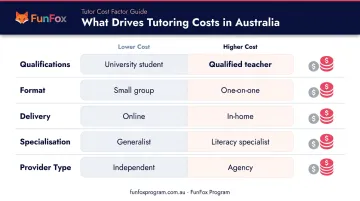
There's no single reliable national average for Australian private tutoring rates. Any dollar figure from a marketplace platform reflects that platform's listings, not an independent survey. What does drive cost:
- Tutor qualifications — a trained teacher charges more than a university student, for good reason
- Format — one-on-one is more expensive than small-group
- Delivery — online often costs less than in-home due to reduced travel
- Specialisation — literacy specialists with structured programs charge more than generalists
- Agency vs. independent — platform fees are built into agency pricing
Making Sense of Value
The cheapest option rarely delivers the best outcome. A university student tutor may charge less per hour, but if sessions lack structure, curriculum alignment, or progress tracking, the hours add up without meaningful results.
For comparison, FunFox programs are priced at $165 monthly for a 3-month term, covering 10 weekly live sessions plus holiday office hours and term-end parent-teacher meetings. That works out to roughly AUD$49.50 per session in a qualified, curriculum-aligned, small-group format — competitive with most one-on-one in-person rates across Australia.
When comparing options, the most useful question isn't "how much per hour?" — it's whether that hour includes qualified teaching, curriculum alignment, and genuine progress tracking.
Questions to Ask Before You Book a Tutor
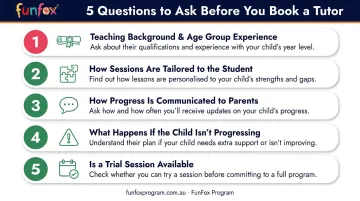
Before committing, ask these five questions — and pay attention to how the tutor or program answers, not just what they say.
What is your teaching background and experience with this age group? A strong answer describes specific experience with primary-aged students and familiarity with Australian curriculum expectations. Generic credentials with no mention of age group or curriculum are a warning sign.
How do you tailor sessions to individual students? Look for evidence of a structured but flexible approach — someone who can explain how they identify gaps and adjust. Avoid tutors who describe a fixed program applied the same way to every child.
How do you communicate progress to parents? Written feedback, regular check-ins, and term reports are all reasonable expectations. If the answer is "I'll let you know if there are concerns," communication is an afterthought — not a priority.
What happens if my child isn't progressing? A quality tutor should have an actual answer — reviewing the approach, raising concerns with parents, adjusting frequency. No answer is a red flag.
Do you offer a trial session? Reputable services offer one. FunFox runs a free trial class each term for new families. If a provider pushes for full-term commitment before you've seen a single session, that's worth questioning.
The booking process itself signals quality. Look for transparent pricing, a clear session structure, and straightforward cancellation policies. Any provider that rushes you to commit before answering these questions is telling you something important.
Frequently Asked Questions
How much do private tutors charge per hour in Australia?
Rates vary by qualification, format, and subject. University-student tutors generally charge less than qualified teachers, and one-on-one sessions cost more than small groups. Specialist literacy programs are often priced per term rather than per session, which can offer better overall value.
Is one hour of tutoring per week enough?
For most primary students, one structured hour per week produces meaningful progress when sessions are consistent and curriculum-aligned. Children with significant gaps may benefit from more frequent sessions over a focused period — higher frequency over a short, concentrated block tends to produce stronger results.
Is private tutoring worth the money?
Yes, when it's well-matched to the child's needs. EEF research finds one-to-one tuition adds around 5 months of additional learning on average. Value depends on tutor qualifications, session regularity, and alignment with what the child is learning at school.
How do I know if my child needs a private tutor?
Key signals: falling behind on reading or writing, low confidence around schoolwork, or direct teacher feedback about gaps. Early intervention produces better outcomes — research shows first and second graders respond significantly more strongly to reading intervention than third graders given the same support.
What is the difference between online and in-person tutoring?
In-person offers physical presence, which can help younger children build focus. Online offers flexibility, broader access to specialists, and often equivalent outcomes when sessions are live, interactive, and led by qualified teachers. The quality of the program matters more than the delivery mode.