Introduction
Children who read widely tend to write with greater confidence, express ideas more clearly, and perform better academically. Most parents know this — but the gap between knowing it and acting on it often comes down to one question: which books actually make a difference?
The answer isn't flashcards or word lists. Children build vocabulary by encountering rich language in books they genuinely want to finish. Research by Cunningham and Stanovich found that print exposure correlates directly with vocabulary, general knowledge, and spelling — and the effect compounds the more children read.
That makes book choice matter more than most parents realise. This guide covers 10 carefully chosen books to improve vocabulary for primary school-aged children (roughly ages 5–12), practical tips for choosing the right book for your child, and simple strategies to get the most out of every read.
Key Takeaways
- Wide reading builds vocabulary faster and more durably than drilling word lists.
- The 10 books span ages 5–12 — from picture books for early learners to rich fiction for upper primary.
- Books are selected based on vocabulary richness, engagement, and age-appropriateness.
- Pair these reads with a word journal to lock in new vocabulary faster.
- FunFox's Readers Club can complement independent reading with guided vocabulary and comprehension practice.
Why Books Are One of the Best Ways to Build Vocabulary
There is a compounding quality to reading that word lists simply cannot replicate. Researchers call it the "Matthew Effect" — early readers gain vocabulary, which improves comprehension, which lets them tackle harder books, which builds more vocabulary still.
Children who fall behind early often find the gap widening, not narrowing, as they move through school.
Context Makes Words Stick
When a child reads "radiant" in Charlotte's Web — used at a precise emotional moment in the story — they absorb not just its dictionary definition but its tone, weight, and feel. Nagy, Herman, and Anderson's landmark 1985 study found that children acquire word meanings from context during normal reading, even without explicit instruction.
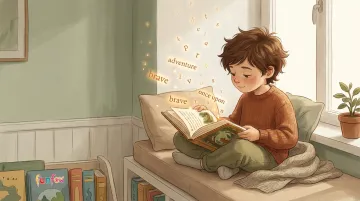
A word encountered in a meaningful story is far more memorable than a word on a list — and fiction delivers that meaning-making naturally, page after page.
How Many Exposures Does a Child Need?
Multiple encounters matter. Research cited by ASCD points to 12–20 meaningful exposures before a word becomes embedded. Reading across different books and genres naturally provides those repeated encounters — especially when children meet the same word used differently across multiple texts.
No single book will do it alone. But a steady reading habit — spanning different genres, styles, and levels of challenge — gives children the volume of exposure that makes new words genuinely stick.
10 Best Books to Improve Vocabulary for Children
These books were chosen based on three clear criteria:
- Vocabulary richness — words that stretch children beyond everyday speech
- Age-appropriateness — matched to primary school reading levels (Ages 5–12)
- Proven engagement — titles that children actually want to read, not just study
1. The Word Collector — Peter H. Reynolds (Ages 5–8)
A picture book about a boy who collects words the way others collect stamps or coins — celebrating the beauty and power of language. Reynolds introduces children to the idea that words have texture, weight, and joy attached to them.
Why it builds vocabulary: It sparks genuine curiosity about unusual and interesting words, and is a natural prompt for starting a family "word collection" habit. Scholastic uses it directly in classroom word-study activities.
2. Colossal Words for Kids — Colette Hiller (Ages 7–12)
A dedicated vocabulary book presenting impressive, unusual words through vivid definitions and illustrations. It won the 2025 CLiPPA (Children's Poetry and Literature Award), which reflects its quality and child appeal.
Why it builds vocabulary: Each entry presents a challenging word in an accessible, illustrated format — encouraging children to actively incorporate "colossal" words into their everyday speech and writing.
3. Vocabulary Ninja — Andrew Jennings (Ages 7–11)
An activity-based vocabulary guide published by Bloomsbury Education, packed with word lists, exercises, and games designed to make word learning genuinely enjoyable.
What makes it effective: Word lists are tiered by difficulty, so children are challenged at the right level without being overwhelmed. The gamified format keeps motivation high, and it pairs well with fiction reading.
4. Charlotte's Web — E.B. White (Ages 8–12)
The classic story of Wilbur the pig and his extraordinary spider friend Charlotte. A Newbery Honor title and one of the most-taught novels in primary schools worldwide.
Why it builds vocabulary: White's prose is deceptively rich. HarperCollins teaching guides identify vocabulary including "salutations," "untenable," "gratified," "sedentary," and "radiant" — all introduced within emotionally charged scenes that give children strong context clues.
5. Matilda — Roald Dahl (Ages 8–12)
The story of a brilliant, bookish girl who outwits every adult around her. A perennial favourite in Australian primary classrooms.
Why it builds vocabulary: Dahl deliberately uses sophisticated vocabulary within a fast-paced, funny narrative. The Penguin educator's guide identifies words like "formidable," "extraordinary," "nimble," "astounding," and "phenomenal" — all used in situations where the story itself pushes children to understand rather than skip.
6. Collins A Word a Day: 365 Words for Curious Minds — Collins Kids (Ages 7+)
An illustrated word-a-day anthology with a new vocabulary word for every day of the year, complete with definitions and usage examples.
Why it builds vocabulary: The daily habit format ensures consistent, low-pressure exposure across an entire year. This directly mirrors the spaced repetition principle that vocabulary researchers identify as highly effective for long-term retention.
7. The BFG — Roald Dahl (Ages 8–12)
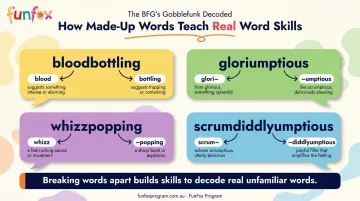
A whimsical adventure featuring the Big Friendly Giant, whose delightfully mangled English ("gobblefunking," "whizzpopping," "gloriumptious") is the core appeal.
Why it builds vocabulary: The BFG's invented language (known as Gobblefunk) teaches children about word structure and meaning by encouraging them to analyse how words are built. When a child works out what "bloodbottling" might mean, they are practising exactly the kind of morphological thinking that helps decode real unfamiliar words.
8. The Secret Garden — Frances Hodgson Burnett (Ages 8–12)
A classic novel about a lonely girl transformed by friendship and nature. Available in Puffin Classics and multiple illustrated editions.
The vocabulary payoff: Burnett's atmospheric, descriptive prose is rich in adjectives and sensory language, sitting well above everyday speech. For older primary readers, few books stretch vocabulary into formal, literary territory as naturally.
9. Percy Jackson and the Lightning Thief — Rick Riordan (Ages 9–12)
The first book in a wildly popular series following a boy who discovers he is the son of a Greek god. Rick Riordan's official site provides teacher guides and classroom resources for this series.
Why it builds vocabulary: The mythology-driven plot embeds Greek and Latin roots throughout: "oracle," "labyrinth," "nemesis," "chaos," "titan." Understanding these roots gives children a practical tool for decoding thousands of unfamiliar English words across all subjects — and the series is engaging enough that children seek out the next book without any prompting.
10. Wonder — R.J. Palacio (Ages 8–12)
A multi-perspective novel about a boy with a facial difference navigating his first year at mainstream school. Published by Penguin Random House.
Why it builds vocabulary: Palacio writes with emotional precision. The multi-narrator structure exposes readers to varied voices and registers, and because the emotional stakes are high, children are genuinely motivated to understand what every character is experiencing — including looking up unfamiliar words to get there.
How to Choose the Right Vocabulary Book for Your Child
Not every book on this list is right for every child. Matching book difficulty to reading ability makes a real difference to how much vocabulary a child actually absorbs.
Use the Five-Finger Rule
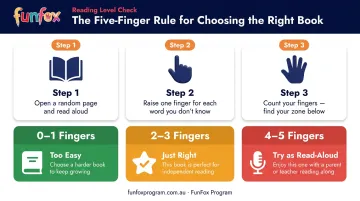
This is a practical classroom technique endorsed by both Reading Rockets and Scholastic:
- Ask your child to open a random page and start reading
- Hold up one finger for each word they cannot read or understand
- Interpret the result:
- 0–1 fingers: Probably too easy for vocabulary growth
- 2–3 fingers: The "just right" zone — challenging without frustrating
- 4–5 fingers: Likely too difficult for independent reading; try it as a read-aloud instead
Match the Book to the Child's Interests
A reluctant reader will gain far more from a book they love than from a "better" book they abandon after three pages. Engagement drives vocabulary acquisition — a child who is genuinely interested in a book will encounter and absorb new words naturally.
Use Both Types of Books
There is a meaningful difference between:
- Vocabulary enrichment books — Vocabulary Ninja, Collins A Word a Day — which provide direct, explicit word instruction
- Story-immersion books — Charlotte's Web, Matilda, Wonder — which build vocabulary through context and emotional engagement
Both types serve children well, and they work best used together. Dedicated word books build explicit knowledge; fiction makes that knowledge stick by putting new words into stories children actually care about.
Conclusion
The most powerful vocabulary gains for primary school children come from consistent, joyful reading — and the right book makes all the difference. Whether your child is drawn to whimsical giants, Greek mythology, or stories about children who outwit the adults around them, there is something on this list that will expand their word bank without feeling like study.
Independent reading pairs well with guided support when you want to take vocabulary development further. FunFox's Readers Club offers Australian primary school students live, small-group online reading sessions — capped at six students — designed to build comprehension and vocabulary in a structured, engaging environment aligned with the Australian curriculum.
Either way, pick one or two books from this list and read alongside your child where you can. Try starting a "word collection" habit together — jot down interesting words you both come across and use one in conversation each day. For structured support, visit funfoxprogram.com.au.
Frequently Asked Questions
What is the best book to improve vocabulary?
The best book depends on your child's age and reading level. The Word Collector works beautifully for ages 5–8; Matilda and Charlotte's Web are ideal for middle primary; Wonder and Percy Jackson suit upper primary readers. In all cases, books where vocabulary is embedded naturally in engaging stories tend to outperform standalone word lists.
What is the best way to expand my child's vocabulary?
Reading widely and regularly remains the most effective approach. Pair that reading with active strategies: keep a word journal, look up unfamiliar words in context, and try using at least one new word in speech or writing within 24 hours of encountering it.
What is the five-finger rule for books?
Open to any page and read aloud — hold up one finger for each word your child doesn't know. Zero to one fingers means the book may be too easy; two to three is the ideal learning zone; four or five suggests the book may be better suited to reading together rather than independently.
At what age should children start reading books to build vocabulary?
Vocabulary development through books can begin from birth — even toddlers aged 3–4 benefit from picture books with rich language. Independent reading typically takes off around ages 6–7 as decoding skills develop, though reading aloud to children beyond that age remains highly valuable.
Can dedicated vocabulary books replace fiction for vocabulary growth?
No — and they work best when used together. Dedicated vocabulary books provide direct, explicit instruction on specific words. Fiction builds vocabulary through context and emotional engagement. The most effective approach for primary school children combines both types of reading consistently over time.
How can parents support vocabulary development at home?
Talk with your child about what they are reading and ask questions when unfamiliar words come up. Encourage them to keep a personal word diary. Most importantly, use new words in everyday family conversation — hearing a word used naturally in context is what moves it from recognised to truly known.