Introduction
Picture this: your child finishes reading a two-page passage about rainforests, closes the book, and stares blankly when you ask what it was about. Or they sit down to write an explanation of how volcanoes work and produce three paragraphs that each start from scratch, with no clear thread connecting them.
Both problems share a common cause — a shaky understanding of text structure.
Text structure is the organisational framework a writer uses to arrange ideas. It's not the topic itself, but the logic that holds the topic together. When children grasp this, reading becomes easier to follow and writing becomes far more purposeful.
This guide breaks down the five main text structure types, why they matter across your child's schooling, and practical ways to build this skill at home.
Key Takeaways
- Text structure is the pattern of organisation in a text — separate from the topic itself
- Recognising structure helps children read with greater comprehension and write with greater clarity
- Five core types are taught in Australian primary schools: description, sequence, cause and effect, compare and contrast, and problem and solution
- Signal words are the fastest clue children can use to spot a structure
- Simple home activities like shared reading build this skill without any special materials
What Is Text Structure in Writing?
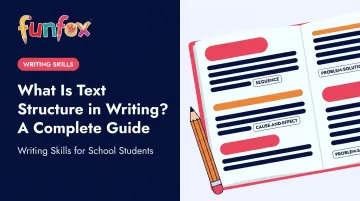
Text structure is the overall pattern a writer uses to arrange and connect ideas. Think of it as the blueprint of a text — it doesn't tell you what the topic is, but it shows how all the parts relate to each other.
This distinction matters. Two passages can both be about climate change, but one might present it as a cause-and-effect relationship (greenhouse gases → rising temperatures), while another compares and contrasts two countries' responses to it. Same topic, very different structures.
Text structure works in both directions:
- As a reader, recognising the pattern helps your child anticipate what's coming next, follow complex arguments, and hold onto key ideas
- As a writer, choosing a structure before starting means ideas connect logically instead of appearing in whatever order they come to mind
How Is Text Structure Different from Text Features?
This is one of the most common points of confusion for both students and parents, so it's worth being direct.
| Definition | Examples | |
|---|---|---|
| Text features | Visual elements that help readers navigate a text | Headings, captions, bold words, diagrams, sidebars |
| Text structure | The underlying logic of how ideas relate to each other | Cause-effect, compare-contrast, problem-solution, sequence |
Text features sit on the surface of the page. Text structure is the underlying logic — invisible, like a skeleton, but responsible for whether the whole thing holds together or collapses.
A text can have excellent features (clear headings, useful diagrams) and still be structurally muddled. Australian schools, including NAPLAN assessments, test these as separate skills, so building both is worth the effort.
Why Text Structure Matters for Your Child's Learning
The Comprehension Benefit
When a child recognises the pattern a text is using, they stop reading word-by-word and start reading purposefully. A student who spots a cause-and-effect structure early knows to look for what triggers what. A student who recognises a problem-and-solution structure knows a proposed remedy is coming and reads to evaluate it.
This reduces the mental effort of processing text and frees up attention for understanding content — which is where real learning happens.
Research backs this up. A 2021 meta-analysis published in Reading Research Quarterly synthesised 44 studies on text-structure instruction for Grades 4–6 and found meaningful positive effects on summarisation, text-structure knowledge, and recall. The International Literacy Association notes that "text structures play an important role in comprehending informational text" and that "understanding text structure strengthens overall comprehension."
The Writing Benefit
Children who understand structure can plan before they write. Instead of opening with an idea and hoping more will follow, they choose a framework and build toward it. The result is more cohesive paragraphs, stronger arguments, and explanations that actually land.
This matters in Australian schools. ACARA documentation shows text-structure awareness developing from Year 1 onward, with increasing control expected through Years 2–6.
NAPLAN assesses text structure directly — in narrative writing through orientation, complication, and resolution; in persuasive writing through introduction, body, and conclusion.
Why It Matters Across All Subjects
Text structure isn't just an English class skill. According to ACARA's Literacy general capability:
- Science relies on description, explanation, sequence, and cause-and-effect reasoning
- HASS (Humanities and Social Sciences) requires sequence, comparison, cause-and-effect, and perspective-based writing
- English builds text structure knowledge explicitly — from simple recounts in Year 1 through to persuasive and analytical writing by Year 6
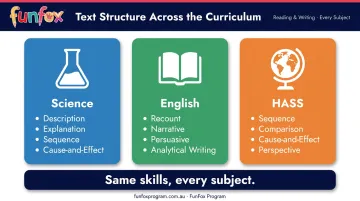
Children who understand these patterns can transfer their reading and writing skills wherever they're needed — not just during literacy blocks.
The 5 Types of Text Structure Explained
Longer texts often blend multiple structures, but Australian primary schools typically teach five core patterns. Each one gives children a reliable toolkit — not just for reading comprehension, but for planning and writing their own pieces.
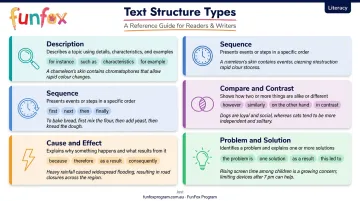
Description
Description structure builds a detailed picture of a topic by layering its features, characteristics, and examples. The author isn't telling a story or making an argument — they're answering the question: What is this thing like?
Children will often spot this structure through phrases like for example, such as, is characterised by, looks like, and includes.
Example: A paragraph describing the features of a rainforest ecosystem — its canopy layers, humidity, and biodiversity.
Sequence (Chronological Order)
Sequence structure presents events or steps in the order they occur — either chronologically (historical events unfolding over time) or procedurally (steps in a process).
Signal words: first, next, then, after that, finally, in [year]
Example: A science passage explaining the stages of the water cycle, moving from evaporation through condensation to precipitation.
Cause and Effect
Cause and effect structure connects events through causality — it shows why something happened or what resulted from an action. Ideas aren't just listed; they're linked.
Signal words: because, as a result, therefore, leads to, this caused, due to
Example: A passage explaining how deforestation reduces tree cover, which disrupts local rainfall patterns and affects biodiversity.
Compare and Contrast
Compare and contrast structure places two or more subjects side by side to examine what they share and where they differ. It appears in comprehension passages and persuasive writing alike — and it's one of the most common structures students encounter in NAPLAN reading tasks.
Signal words: similarly, both, however, on the other hand, unlike, in contrast
Example: A passage comparing life in a city versus a rural town — covering transport, community, access to services, and pace of life.
Problem and Solution
Problem and solution structure opens with a challenge and then explores one or more ways to address it. Unlike cause and effect, the emphasis is on what can be done, not just on what happened.
Signal words: the problem is, one solution, this can be solved by, to address this
Example: A persuasive letter proposing concrete ways to reduce single-use plastic waste at school.
Signal Words: How Children Spot Text Structure
Signal words — sometimes called transition words or linking words — are the most accessible clue children have when identifying structure. Teach your child to pause after finishing a paragraph and look for these markers, then ask: What is this paragraph mostly doing?
The question to keep in mind:
"Is it describing, sequencing, explaining a cause, comparing two things, or presenting a problem and a solution?"
A simple habit for parents: During shared reading of any nonfiction text — a library book, a news article, even a recipe — point to a transition word and ask "What does this word tell us about how these ideas are connected?" This takes thirty seconds and builds exactly the right instinct.
One important caveat: signal words are a useful starting point, not a foolproof system. Some texts use few transitions, or mix structures across paragraphs.
When signal words are scarce, children should also ask: What job is this paragraph doing? That question, focused on purpose rather than vocabulary, tends to get them further.
How to Help Your Child Practise Text Structure at Home
None of these activities require worksheets or special materials. The goal is to make structure-noticing a natural part of how your child reads and writes.
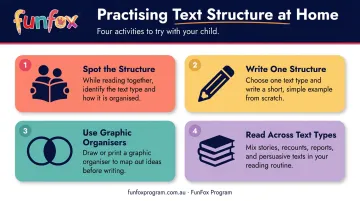
1. Spot the structure during shared reading After reading a short passage together — a news article, a library book, a magazine — ask: "How did the author organise this?" Name the structure together. Over time, this becomes automatic.
2. Write one structure at a time Ask your child to write three sentences using just one structure. For example: compare two animals using "both" and "however." Short, focused practice beats long, unplanned pieces.
3. Use graphic organisers before writing A simple two-column cause → effect table, or a Venn diagram for comparing two topics, gives children a visual scaffold that mirrors the structure they're using. Draw one on any piece of paper — no printing required.
4. Read across text types Expose your child to different kinds of nonfiction: recipes (sequence), science books (cause and effect), encyclopaedia entries (description), opinion pieces (problem and solution). Variety builds recognition across all five structures.
These habits lay a strong foundation — though some children thrive with more consistent, teacher-led practice alongside home activities. FunFox's Writers Club offers structured writing sessions in small groups of up to six students, where qualified teachers give real-time feedback on how children plan and organise their writing. Classes run weekly throughout the school term, building skills steadily over time.
Frequently Asked Questions
How do you explain the structure of a text?
Text structure is the organisational pattern a writer uses to connect ideas — think of it as the blueprint that shows how all the parts fit together. The easiest way to identify it is to ask: "What is this text mostly doing — describing, sequencing, comparing, explaining causes, or presenting a problem and solution?"
What are the 5 types of text structures and examples?
The five types are: description (features of a rainforest), sequence (steps in a science experiment), cause and effect (why deforestation changes rainfall), compare and contrast (similarities between two animals), and problem and solution (ways to reduce plastic waste at school).
Is text structure only for nonfiction writing?
No. While the five structures are most explicitly taught through informational texts, narrative writing has structure too — orientation, complication, climax, and resolution. NAPLAN assesses text structure in both narrative and persuasive tasks, so the skill applies across every text type your child encounters at school.
What is the difference between text structure and text features?
Text features are visual or formatting elements — headings, captions, bold words, diagrams — that help readers navigate a page. Text structure is the underlying logic of how ideas relate to one another. Both support comprehension, but they are assessed as separate skills.
At what age do children start learning text structure?
In Australian primary schools, ACARA documentation shows text-structure awareness developing from Year 1 onward. By Years 3–4, children are explicitly taught to identify and use all five structures in reading and writing. Earlier exposure at home through shared reading gives children a real advantage.