You're not alone. Many parents feel unsure whether their child's storytelling matches what teachers expect at this stage, especially after a school report mentions "narrative structure" or "sentence variety" without much explanation.
This guide breaks it down properly. You'll find real writing samples, ready-to-use prompts, and practical tips grounded in the Australian curriculum, not vague reassurance.
Key Takeaways
- Year 2 stories need a beginning, problem, and ending, not a set word count
- Compound sentences with 'and', 'but', or 'or' are the core skill assessed in Year 2
- The writing samples below show the gap between developing and strong Year 2 stories
- Prompts, oral storytelling, and programs like Writers Club build genuine confidence
What Is Narrative Writing in Year 2?
Narrative writing is storytelling. It has a beginning, a middle, and an end, and it's built around characters doing something, usually facing a problem that gets resolved. That's different from other Year 2 writing tasks your child brings home.
- Recount – retells something that actually happened, in the order it happened (a weekend, an excursion)
- Information report – presents facts about a topic, like "Facts About Sharks"
- Narrative – tells a story, real or invented, with a character-driven problem and resolution
Year 2 (ages 6–7) is when children make this leap, moving from simple, standalone sentences to sequencing events into a proper story arc. The Australian Curriculum's AC9E2LY06 content description asks students to create short imaginative texts using purpose-appropriate structure, simple and compound sentences, and topic-specific vocabulary.
Common formats your child will practise this year include:
- Personal narratives (a memory told as a story)
- Fictional adventures (invented characters and settings)
- Transformations of traditional tales (a new version of a fairy tale or fable)
Each format uses the same underlying structure, just with different content.
What Should Year 2 Narrative Writing Look Like?
This is the section most parents actually want. Here's what teachers are genuinely looking for, without the jargon.
Story Structure
A strong Year 2 narrative includes:
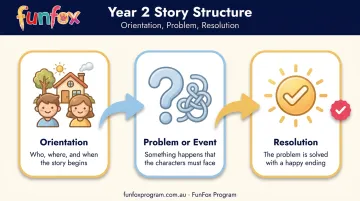
- Orientation – who is in the story, where it happens, and when
- Problem or event – something goes wrong, changes, or needs solving
- Resolution – the problem gets sorted, and the story wraps up
NSW curriculum guidance describes this using characters, setting, a problem connected to what a character wants, complications, and a resolution. Think of it as scaffolding, not a rigid formula every story must follow exactly.
Sentence-Level Skills
At this stage, children are expected to:
- Use capital letters, full stops, and question marks correctly and consistently
- Write mostly in past tense, with reasonably consistent tense throughout
- Join ideas using coordinating conjunctions: and, but, or
- Begin experimenting with simple subordinating conjunctions like when, if, because, that
The coordinating conjunctions are the main assessed skill here. Subordinating conjunctions often start appearing in stronger Year 2 writing, but they're a bonus, not a requirement every child must hit.
Showing, Not Just Telling
This is the marker that separates competent writing from truly strong writing. Compare these two lines:
- "I was scared." (telling)
- "My heart was pounding and my hands felt cold." (showing)
The second version demonstrates a skill worth encouraging early, because it's the foundation for descriptive writing in later years.
Mechanics Still Being Assessed
Don't overlook the basics still under development:
- Phonics-based spelling attempts at unfamiliar words (for example, "wonted" for "wanted")
- Correctly formed, unjoined capital and lowercase letters
- Appropriate spacing between words
Quick checklist for parents: Tick off what you can see in your child's writing:
- A clear who, what, and where
- A problem and an ending
- Sentences joined with and/but/or
- Full stops and capitals mostly correct
Three or four ticks means your child is tracking well.
Year 2 Narrative Writing Samples: Real Examples Broken Down
Seeing an actual sample makes all of this click. Here are two, broken down line by line.
Personal Narrative Example
"Last Saturday, my tooth fell out at breakfast. First, I felt it wiggling with my tongue. Next, I bit my toast and it popped out! Then Mum put it in a little box for the tooth fairy. Finally, I found two dollars under my pillow. It was the best morning ever."
What makes this work:
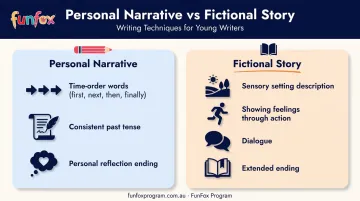
- Time-order words (first, next, then, finally) for clear sequencing
- Consistent past tense throughout ("fell," "felt," "bit," "found")
- A short personal reflection at the end for a satisfying close
Fictional Story Example
"Deep in the forest, a small fox named Pip heard a strange rustling behind the bushes. His heart began to pound. Slowly, he crept forward and saw a baby owl stuck in a tangle of vines. "Please help me!" the owl cried. Pip pulled gently until the owl was free. From that day on, they were the best of friends."
Craft techniques worth noticing:
- Sensory setting description ("deep in the forest," "tangle of vines")
- Showing feelings through physical reaction ("his heart began to pound")
- Dialogue that moves the story forward
- An extended ending (a lasting friendship, not just "the end")
Both examples show what strong Year 2 writing looks like, but most children hit the same snags along the way. Common growth area: many Year 2 writers repeat the same sentence opener ("Then... Then... Then...") or write choppy, disconnected sentences. A simple fix: ask your child to start one sentence with a describing word, one with a character's name, and one with a time word. Small variety goes a long way.
Year 2 Story Writing Prompts to Inspire Your Child
Blank page syndrome hits six and seven-year-olds too. These prompts, grouped by type, give your child somewhere to start.
Personal narrative prompts:
- Write about your favourite memory from a holiday or birthday
- Describe the best day you've ever had with a friend or pet
- Tell the story of a time you felt really proud of yourself
Imaginative prompts:
- You find a key that opens any door in the world. Where do you go?
- You spot a talking animal in your backyard. What happens next?
- You discover a magic paintbrush. What do you paint, and what comes to life?
"What if" scenarios:
- What if you woke up as small as an ant for one day?
- What if your shoes let you jump higher than any building?
- What if you could talk to your pet for one whole afternoon?
Before your child starts writing, a quick planning step helps enormously. A simple story mountain (beginning, problem, events, ending) or a character profile (name, look, personality, what they want) reduces overwhelm and gives structure before the pen even hits the page.
Tips to Support Your Child's Narrative Writing at Home
Small, consistent habits do more than occasional big pushes.
Read aloud daily, and talk about word choices. Pause occasionally and ask, "why do you think the author called it gloomy instead of dark?" This kind of targeted vocabulary discussion during shared reading has been shown to support word learning in young children, according to an ACER review of reading research. Reuse the word later that day if you can.
Practise oral storytelling before writing, too. Ask your child to retell a familiar tale, such as Little Red Riding Hood, in their own words. This builds confidence with story structure before they have to manage handwriting and spelling at the same time.
With that confidence growing, create real reasons to write:
- A short diary entry about their day
- A birthday card with a personal message
- A one-page story about their favourite toy
These low-pressure tasks keep motivation up because the writing has a genuine purpose.
Consider structured, expert support. Home practice helps, but some children benefit from consistent, guided feedback.
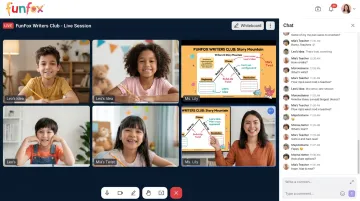
FunFox Program's Writers Club runs small-group live online classes, capped at six students, with structured digital worksheets and personalised feedback through Seesaw. The program pairs story-structure teaching with creative encouragement, rather than just correcting mistakes after the fact.
Frequently Asked Questions
What are some Year 2 narrative writing prompts?
Good options mix personal prompts (a favourite memory, the best birthday) with imaginative ones (a magic object, an animal adventure). See the full prompt list above for ready-to-use options.
What are examples of Year 2 narrative writing?
Strong examples include personal narratives, like a lost-tooth story, and short fictional pieces with dialogue and a resolved problem. Both types need a clear beginning, middle, and end, as shown in the samples above.
What should Year 2 narrative writing look like?
It should have a clear orientation, a problem or event, and a resolution. Sentences should show mostly correct punctuation, consistent past tense, and simple conjunctions like and, but, or joining ideas.
How long should a Year 2 child's narrative writing be?
There's no strict word count in the national curriculum; the official wording simply calls for a "short" text. A few sentences to a short paragraph or two is typical, with structure mattering more than length.
How can I tell if my child's writing meets Year 2 expectations?
Check for the markers covered earlier: clear structure, mostly consistent tense, correct punctuation, and conjunctions joining ideas. For a more precise read, ask your child's teacher or a tutor for direct feedback.
What is the difference between a recount and a narrative in Year 2?
A recount retells real events in the order they happened, like a weekend diary entry. A narrative builds a story around a character-driven problem and resolution, and can be entirely fictional.