Introduction
Picture this: your child comes home from school, sits down with their reader, and stares at a word they don't recognise. Instead of sounding it out, they glance at the picture for a clue. It works sometimes — but you notice it happening again and again. Is this normal? Is it how reading is supposed to be taught?
Many Australian parents of Foundation-to-Year 3 children ask exactly these questions — and most aren't sure whether to raise concerns with the teacher, look for extra support, or hold off a little longer.
This article unpacks two frameworks worth understanding: the Science of Reading and Tier 1 literacy instruction.
You'll learn what quality classroom reading instruction actually looks like, how to spot the signs of strong (or weak) practice, and what to do if your child needs more support than the classroom can provide.
Key Takeaways
- The Science of Reading is a research-backed body of knowledge built around five core pillars — from phonemic awareness through to comprehension
- Tier 1 instruction is the core reading instruction every child receives — it is the foundation of the entire literacy support system
- Strong Tier 1 curricula are explicit, systematic, and aligned with the Science of Reading. Parents can learn to spot the difference.
- Australia has committed to evidence-based reading instruction, signalled by the Australian Curriculum v9.0 and the national Year 1 Phonics Check
- When Tier 1 isn't enough, early supplemental support is the most effective response — not watching and waiting
What Is the Science of Reading?
The Science of Reading is a vast, interdisciplinary body of research about how children learn to read — and what goes wrong when they don't. As The Reading League defines it, it draws on cognitive science, linguistics, neuroscience, and decades of classroom research. It's not a single program or brand. It's the accumulated evidence base that shapes what effective reading instruction should look like.
The Five Pillars
The landmark National Reading Panel report identified five core components that reading instruction must address:
| Pillar | What It Means |
|---|---|
| Phonemic awareness | Hearing and manipulating individual sounds in spoken words |
| Phonics | Linking letters to sounds to decode written words |
| Fluency | Reading with accuracy, speed, and appropriate expression |
| Vocabulary | Knowing what words mean in context |
| Comprehension | Understanding the meaning of what's been read |
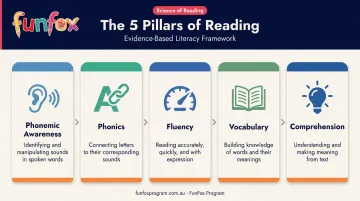
These five areas work together, not in isolation. A child who decodes fluently but has thin vocabulary will still struggle to understand what they're reading. Rich oral language won't save a child whose phonics are shaky once text complexity climbs.
Why Early Years Matter So Much
Research consistently shows that children who receive reading intervention in Year 1 or Year 2 make substantially greater gains than those who first receive support in Year 3 or later. Research by Lovett and colleagues confirmed that earlier structured intervention produces stronger outcomes in basic reading skills. The Foundation–Year 2 window carries outsized weight — early gaps compound quickly if left unaddressed.
Explicit vs. Implicit Instruction
"Explicit and systematic" instruction means the teacher directly models each skill, introduces patterns in a deliberate sequence from simple to complex, and provides immediate corrective feedback. Children aren't expected to absorb phonics rules through exposure alone. The alternative — asking a child to guess an unknown word from the picture or the first letter — is sometimes called three-cueing, and it's not supported by reading science. Strong phonics instruction teaches children to work through words sound by sound, not to approximate using context.
The Australian Context
Australia has been moving decisively toward evidence-based reading instruction. The Australian Curriculum v9.0 explicitly includes phonics and phonic knowledge from Foundation through Year 2. The Year 1 Phonics Check — a short individual assessment of decoding skills — is now mandated or implemented across every state and territory, from South Australia (which introduced it in 2018) to Victoria (mandated from 2026) and the ACT (commenced 2024).
This is a national signal that systematic phonics belongs in every classroom.
Understanding the Tier 1, 2, and 3 Literacy Framework
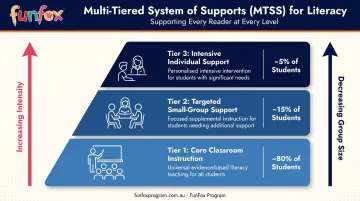
Schools don't deliver reading instruction in a one-size-fits-all way. The Multi-Tiered System of Supports (MTSS) — described by AERO, Australia's education research organisation — provides a continuum of support matched to each student's needs. That continuum is organised into three tiers, each representing a different level of instructional intensity.
The Three Tiers Explained
- Tier 1 — Core Classroom Instruction: The structured, evidence-based reading instruction every student receives from their classroom teacher. When delivered well, most students reach reading benchmarks through Tier 1 alone.
- Tier 2 — Targeted Small-Group Support: For students not making expected progress with Tier 1 alone. Delivered in addition to core instruction — not instead of it — typically in small groups targeting specific skills like phonics or fluency. The IES practice guide on reading RTI recommends groups of three to eight students, meeting three to five times per week.
- Tier 3 — Intensive Individual Support: For students with persistent or significant reading difficulties. This may involve specialist reading intervention and assessment for learning differences such as dyslexia.
Tiers Are Flexible, Not Fixed Labels
The tiers don't label children as "good" or "bad" readers. They describe the intensity of instructional support a child needs at a given time. Children move between tiers as their skills develop — Tier 2 support is not a permanent category.
What Does Strong Tier 1 Instruction Look Like in Early Elementary?
A Science of Reading-aligned Foundation-to-Year 2 classroom has some recognisable features. The IES Foundational Skills practice guide outlines core components for K–3 reading instruction that map closely to what parents should expect to see.
Daily Phonics With a Clear Sequence
Each lesson builds on the last, moving from simple letter-sound correspondences to more complex patterns in a deliberate sequence. Students apply what they've been taught — not in random order — so skills compound over time. By mid-Year 1, most children should be blending and segmenting words with confidence.
Decodable Texts
Decodable books are designed so early readers practise only the phonics patterns they've already been taught — giving them a genuine chance to apply decoding skills rather than guess from context or pictures.
The NSW Department of Education defines decodable texts as designed specifically for beginning readers to practise taught letter-sound relationships. They differ from levelled readers, which may contain words far beyond what a child has been taught to decode, pushing children toward guessing rather than decoding.
Regular Progress Monitoring
Strong Tier 1 instruction includes systematic check-ins on every child's reading development. Teachers don't wait for end-of-year reports to identify who needs more support. Formal monitoring at least twice a year — at the start and middle — allows early identification of children who may benefit from Tier 2 support before small gaps become large ones.
As a parent, you can also pick up on these markers at home. Here's what healthy Tier 1 progress tends to look like day-to-day:
Signs of Strong Tier 1 at Home
- Your child attempts to sound out unfamiliar words rather than skipping them or guessing
- They're learning spelling patterns in a clear, building sequence
- Their reading confidence increases steadily across the year
- They can retell or discuss what they've read, not just decode it
How Parents Can Tell If Their Child Is Getting Quality Literacy Instruction
At your next parent-teacher conversation, these questions will tell you a lot about how reading is being taught:
- Is phonics taught explicitly, with a clear scope and sequence?
- What decodable texts does my child bring home, and how are they selected?
- How often do you assess reading progress, and what do you do with that data?
- If my child isn't progressing as expected, what's the next step?
The answers to those questions will give you a baseline. Beyond that, it's worth knowing what to watch for at home.
Warning Signs Worth Noting
Not every school has fully transitioned to Science of Reading-aligned practice. Be alert to these patterns:
- Your child is consistently encouraged to skip words and guess from pictures
- Reading instruction relies heavily on whole-word memorisation without a phonics foundation
- Your child's reading progress stalls across a term, but no additional support is offered or discussed
- Decodable books are absent from the early reading materials sent home
No single sign tells the full story. But if several of these patterns apply, raise them directly with your child's teacher — a good school will welcome the conversation.
What to Do When Tier 1 Instruction Isn't Enough
Even with genuinely excellent Tier 1 instruction, some children will need additional support. This is not a failure of the child or the teacher — it reflects natural variation in how children develop reading skills. Research by Wanzek and colleagues confirms that intensive early reading interventions produce positive gains for struggling readers, particularly when started early.
The critical word there is early. Waiting to see if a child "catches up" is one of the more damaging choices a family can make. Reading gaps that aren't addressed in Foundation–Year 2 tend to compound as curriculum demands increase in Year 3 and beyond.
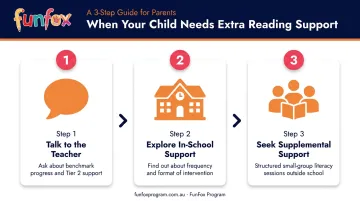
Practical Steps for Parents
- Ask the teacher directly whether your child is progressing at benchmark and whether Tier 2 support has been considered
- Find out what additional in-school support looks like and how frequently it occurs
- Look for structured supplemental support outside school — small-group literacy sessions can reinforce the foundational skills being taught in class
Programs like FunFox's Readers Club offer structured, small-group online literacy sessions aligned with the Australian Curriculum — giving children focused reading practice and the encouragement that builds confidence alongside skills.
For Year 1–2 students specifically, the FunFox Foundation Club is a hybrid reading and writing program targeting early elementary literacy. Both programs work alongside classroom instruction rather than replacing it — a Tier 2-style complement backed by research.
Lovett et al.'s 2017 research is clear: children who receive structured support in Year 1 or Year 2 consistently outperform those who first access intervention in Year 3. That window matters.
Frequently Asked Questions
What is Tier 1 instruction in Science of Reading?
Tier 1 instruction refers to the core, whole-class reading instruction all students receive. When aligned with the Science of Reading, it includes explicit, systematic teaching of phonics, phonemic awareness, fluency, vocabulary, and comprehension — delivered by a trained classroom teacher using an evidence-based curriculum.
What is Tier 1, Tier 2, and Tier 3 literacy?
Tier 1 is universal classroom instruction for all students. Tier 2 is targeted small-group support for students not progressing with Tier 1 alone. Tier 3 is intensive, individualised intervention for students with significant reading difficulties — and children can move between tiers as their skills develop.
What is an example of Tier 1 instruction for reading?
Examples include daily explicit phonics lessons following a clear scope and sequence, guided oral reading for fluency practice, and vocabulary-building through structured read-alouds — all delivered to the whole class as part of regular school literacy time.
How do I know if my child's school uses the Science of Reading?
Ask the teacher whether phonics is taught explicitly and in a systematic sequence, whether the school uses decodable books in the early years, and how reading progress is monitored.
What should I do if my child is struggling despite receiving Tier 1 instruction?
Speak with the teacher about whether Tier 2 small-group support is available. It's also worth considering a structured supplemental literacy program outside school — one that reinforces foundational skills in a small-group, evidence-based setting for consistent practice beyond the classroom.
At what age should children start formal reading instruction in Australia?
Formal reading instruction typically begins in the Foundation year, around age 5, though cut-off dates vary by state. Phonemic awareness activities begin even earlier — the Australian Curriculum v9.0 places phonological awareness in Foundation year. Building oral language, vocabulary, and a love of books before school creates a strong foundation for everything that follows.