
Reading comprehension is a learnable skill, not a fixed talent. The RAND Reading Study Group defines it as "the process of simultaneously extracting and constructing meaning through interaction and involvement with written language" — which means it requires active participation, not passive page-turning. The good news: comprehension improves when readers follow deliberate strategies before, during, and after reading.
This guide covers exactly that. You'll find a step-by-step reading method, the key factors that shape how well information is absorbed, what to do before opening a book, common habits that quietly sabotage understanding, and when to apply active reading techniques — and when to put them away.
Key Takeaways
- True comprehension requires active engagement before, during, and after reading.
- Previewing a book and setting a clear purpose dramatically improves focus and retention.
- Visualising, pausing to reflect, and paraphrasing lock in comprehension while reading.
- Skipping previews, reading without purpose, and never reviewing are the habits most likely to hurt comprehension.
- Children who build structured reading habits early develop stronger critical thinking.
How to Read a Book and Understand It: Step by Step
Deep understanding doesn't come from reading faster or more often. It comes from a consistent process — before, during, and after reading.
Step 1: Preview Before You Begin
Previewing means scanning the title, cover, back blurb, table of contents, chapter headings, and any bold or highlighted text before reading a single full sentence. This primes the brain to organise incoming information rather than receive it as an unconnected stream.
For children especially, previewing serves another purpose: it sparks predictions and questions. When a reader wonders "Will the main character solve that problem?" or "What does this chapter title mean?", the brain now has a goal to work toward. That goal sharpens attention during reading.
Step 2: Set a Reading Purpose
Entering a book with a specific intention changes how the brain processes what it reads. A question like "What will I learn about friendship from this story?" acts as a mental filter — it tells the brain what to pay attention to and what to hold onto.
For children, purpose-setting transforms reading from a passive task into a goal-directed activity. Think of the difference between watching a film casually and watching it knowing you'll need to describe the plot afterwards. The content lands differently.
Step 3: Read Actively and Engage While Reading
Active reading doesn't mean underlining every line. It means staying in conversation with the text. Practical techniques for children and students include:
- Underlining or flagging key passages that answer the reading purpose set in Step 2
- Writing short margin notes or sticky-note observations — even one word captures a reaction
- Asking "why?" and "what does this mean?" at the end of each section before moving on
- Visualising characters, settings, and events as mental pictures — Reading Rockets describes this as forming "mind movies" that help clarify and remember text
Younger readers do better in short, focused segments — a few pages at a time — rather than pressing through to a chapter break when tired or confused. After each segment, ask them to paraphrase what just happened before turning the page.
Step 4: Pause and Reflect at Key Moments
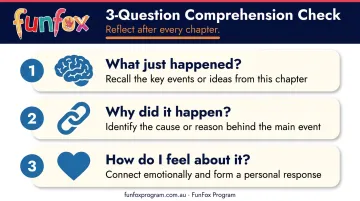
Brief reflection breaks at the end of chapters consolidate understanding and catch gaps before they compound. Three simple questions work well for children:
- "What just happened?" Tests whether the child can recall the main events without prompting.
- "Why did it happen?" Checks whether they understood cause and effect, not just plot.
- "How do I feel about it?" Connects emotion to content — and when readers attach a feeling to what they've read, the brain encodes it more durably. A chapter that made a child angry or surprised is a chapter they'll remember.
Step 5: Review and Apply After Finishing
Research on effective learning techniques consistently shows that active recall — testing what you remember — beats rereading for long-term retention. For reading, this means:
- Summarising the book in 2–3 sentences from memory before checking notes
- Revisiting highlights to confirm understanding, not just to reread passively
- Discussing the book with a parent, sibling, or classmate
The most reliable test of genuine comprehension is the "teach-it-back" method: if a child can explain what they read to someone else in simple terms, they understood it. Gaps in their explanation reveal exactly where comprehension broke down — which is far more useful than a blank stare at a comprehension question.
Key Factors That Affect Reading Comprehension
Even with the right method, comprehension varies. Several underlying factors shape how well a reader absorbs and retains what they read — and understanding these helps parents make better decisions about book choice, environment, and support.
Reading Level Match
When a text sits too far above a reader's current level, cognitive load overtakes comprehension. The reader decodes words but loses meaning. Too easy, and engagement drops.
Vygotsky's Zone of Proximal Development (ZPD) describes this zone — the space between what a child can read independently and what they can manage with support. Historical guidance from reading researcher Emmett Betts, cited in Stange's 2013 review, suggests independent reading works best when a child can accurately read around 99% of words with 90% comprehension. Text difficulty must be matched to the reader — these benchmarks show why.
Prior Knowledge and Background Context
A well-known 1988 study by Recht and Leslie demonstrated that prior knowledge about a topic can matter more than reading ability itself. Students with strong background knowledge on baseball outperformed more skilled readers who lacked that context — because they had existing mental frameworks to attach new information to.
A 2-minute context check before starting a new book — looking up the author, historical period, or topic — gives the brain scaffolding that makes the content stick.
Attention and Environment
Reading requires sustained, directed attention. Distractions don't just interrupt reading; they fragment comprehension even when the child is technically looking at the page.
A Bayesian meta-analysis of 65 studies on auditory distraction found that background noise, speech, and music had a reliable negative effect on reading performance (overall effect size: Hedges's g = -0.21). The effect held equally for children and adults. A quiet, dedicated reading space isn't a luxury — it's a comprehension tool.
Emotional Engagement and Personal Relevance
When children care about what they're reading — because it connects to their interests, experiences, or current questions — they read more attentively and retain more. A study of 92 Year 4 children found that reading choice improved comprehension outcomes across attentional profiles.
Helping a child choose books tied to what they're currently curious about matters as much as matching the right reading level. When both align, comprehension follows.
Preparing to Read: What to Do Before You Open a Book
Preparation shapes what a reader gets out of a book before a single page is turned. Skipping this phase is one of the most common reasons comprehension suffers — especially for children assigned reading they didn't choose.
Choosing the Right Book
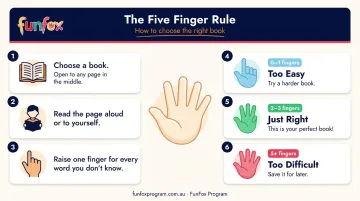
The Five Finger Rule is a practical self-assessment tool for young readers selecting books independently. Here's how it works:
- Open to any page in the book
- Read the page aloud or silently
- Hold up one finger for each word you don't know or can't figure out
- Zero to one fingers — the book may be too easy for learning, though fine for pleasure
- Two to three fingers — a good challenge level for reading with some support
- Five or more fingers — the book is likely too difficult for comfortable independent reading
Reading Rockets frames this similarly, noting that independent reading is best supported by texts where a child can accurately read at least 95% of words.
Beyond difficulty level, choosing books connected to a child's current interests, questions, or goals builds motivation before a word is read. When a child genuinely wants to read something, comprehension tends to follow more naturally.
Creating the Right Reading Environment
Before sitting down to read, a few simple setup steps make a measurable difference:
- Choose a quiet, well-lit space away from screens and background noise
- Put devices on focus mode or out of reach — even a phone face-down on the table creates distraction
- Have a pencil or sticky notes nearby for active reading
- Set a realistic time block — 10–15 minutes for younger readers, longer for older students
FunFox's Readers Club takes care of this setup for families. In groups of no more than six students, trained teachers guide children through structured reading sessions — the kind of focused environment where comprehension strategies get the chance to stick.
Common Reading Mistakes That Hurt Comprehension
Most comprehension struggles trace back to a handful of avoidable habits. Knowing which ones apply makes them easier to fix.
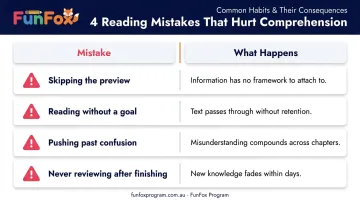
The four most common culprits:
- Skipping the preview — jumping straight into text without checking headings, chapter structure, or the blurb. Without that scaffolding, new information has nowhere to stick.
- Reading without a goal — passive readers reach the last page but can't explain what they read because they weren't actively looking for anything. The text passes through rather than landing.
- Pushing past confusion — children especially keep reading after sentences they didn't understand, assuming clarity will come. It rarely does. Confusion compounds quietly across chapters until understanding has already broken down.
- Never reviewing after finishing — moving straight on to the next book means newly formed knowledge fades within days. Even a five-minute conversation about what was read makes a measurable difference to retention.
The pattern across all four mistakes is the same: treating reading as a performance (finishing pages) rather than a process (building understanding). Once a reader starts asking "did I actually understand this?" instead of "did I finish this?", the other habits tend to follow.
When Active Reading Matters Most
Active reading strategies — previewing, annotating, pausing, reviewing — are most valuable when reading for a specific purpose:
- School assignments that require discussion, analysis, or written response
- Complex non-fiction where the reader needs to extract and apply information
- Books a child will need to explain, summarise, or answer questions about
- NAPLAN preparation and texts read for assessment
Applying maximum effort to every book creates fatigue, and it can quietly chip away at a child's enjoyment of reading.
Relaxed pleasure reading carries its own genuine benefits: vocabulary exposure, background knowledge, reading motivation, and the comprehension that builds through volume and enjoyment. Protecting a child's love of reading matters as much as building their analytical skills.
A useful rule of thumb: use active reading strategies when the goal is learning or demonstrating understanding. Read lightly when the goal is enjoyment and habit. Strong readers know when to shift gears — and that flexibility is a skill worth developing early.
Frequently Asked Questions
What is the best way to read and understand a book?
The best approach combines three phases: preview the book before starting (scan headings, blurb, and structure), read actively with a clear purpose in mind, and review key points afterwards through recall or discussion. Each phase reinforces the others, which is why skipping the preview or the review tends to weaken retention.
What is the Five Finger Rule for books?
The Five Finger Rule is a simple self-assessment for young readers: open to any page, read it, and raise a finger for every word you don't know. Five or more raised fingers signals the book is likely too difficult for comfortable independent reading and a slightly easier choice may build comprehension better.
Does reading help reduce stress?
A 2009 study by Dr David Lewis at the University of Sussex found that reading reduced reported stress markers — including heart rate and muscle tension — in volunteers. The research didn't specifically measure cortisol, and the sample was small, but it supports reading as a genuine relaxation tool for children and adults alike.
How can I help my child remember what they've read?
Three strategies consistently help:
- Ask open-ended questions after reading ("What was your favourite part and why?")
- Encourage your child to retell the story in their own words
- Revisit the book briefly one or two days later — the gap between readings strengthens retention
How many minutes should a child read each day to improve comprehension?
South Australia's Department for Education advises that 5 to 10 minutes of reading every day is more effective than a single longer session once a week. Short daily sessions build reading habit gradually, while occasional longer sessions don't give the brain enough regular practice to strengthen comprehension over time.
What is the difference between reading and reading comprehension?
Reading is the mechanical act of decoding words and sentences. Reading comprehension is the ability to extract meaning, make inferences, and connect ideas. As the Simple View of Reading makes clear, fluent decoding doesn't automatically produce comprehension — comprehension requires its own targeted practice, separate from phonics and word recognition.