The short answer: most paragraphs contain somewhere between 3 and 8 sentences. But that range is a guideline, not a grammatical law. The real measure of a paragraph is whether it does its job — introduces an idea, develops it clearly, and wraps it up before moving on.
This matters especially for Australian primary school families. Whether your child is working through a Year 4 persuasive essay or a Year 6 narrative, understanding what actually makes a paragraph work — rather than just counting sentences — is the skill that transfers. This post breaks down the practical answer, the building blocks of a strong paragraph, common mistakes children make, and what the Australian curriculum actually expects at each stage.
Key Takeaways
- Most paragraphs work best with 3–5 sentences; academic writing can stretch to 8
- Quality depends on idea completeness — a paragraph is done when its point is made
- The Australian Curriculum builds paragraph skills progressively from Year 3 onward
- Online paragraphs often run 1–3 sentences; academic essays allow much more
- For young writers, one clear idea per paragraph is the most reliable starting rule
How Many Sentences Should Be in a Paragraph?
The practical answer most writing guides land on: 3 to 5 sentences for most school writing, with up to 8 acceptable for more complex academic arguments.
Purdue OWL, one of the most widely referenced writing authorities in English-language education, puts it this way: "Aim for three to five or more sentences per paragraph" — while also noting there are "no set rules" about sentence count. A paragraph is a unit of thought, not a unit of measurement.
The Classic School Rule of Thumb
Most primary school teachers introduce paragraphs using a three-part model:
- Topic sentence — states what the paragraph is about
- Supporting sentences — provide evidence, examples, or explanation (usually 2–4 sentences)
- Concluding or linking sentence — wraps up the idea or connects to the next paragraph
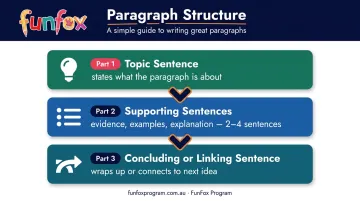
That gives you 4–6 sentences naturally, which is why this range feels "right" in most school contexts. It's not arbitrary — it's the minimum needed to actually develop an idea rather than just mention it.
What Sentence Count Actually Signals
Here's a concrete comparison:
2-sentence paragraph (underdeveloped): Dogs make great pets. They are loyal animals.
5-sentence paragraph (complete): Dogs make excellent pets for families with children. They are naturally loyal and tend to form strong bonds with the people they live with. Studies show that children who grow up with dogs develop stronger empathy skills. Dogs also encourage outdoor activity, which benefits the whole family. For these reasons, many child development experts recommend pets as part of a healthy home environment.
The second paragraph introduces a clear claim, backs it with specific reasoning, and lands a conclusion. That's what makes a paragraph complete — not hitting a particular number. As Purdue OWL puts it: "Keep one idea to one paragraph." If a student finds themselves writing about two different things, that's the signal to split, regardless of how many sentences they've already written.
Why There's No One-Size-Fits-All Rule
Paragraph length norms shift dramatically depending on where and why you're writing. What earns full marks in a school essay would look out of place in a newspaper, and vice versa.
Writing Context Changes Everything
| Writing Type | Typical Paragraph Length | Primary Reason |
|---|---|---|
| School/academic essays | 4–6 sentences | Need evidence, explanation, conclusion |
| Creative fiction | 1 sentence to 1 paragraph | Dialogue, pace, dramatic effect |
| News articles | 1–2 sentences | Speed, clarity, mobile reading |
| Online/blog content | 2–3 sentences | Scannability, white space |
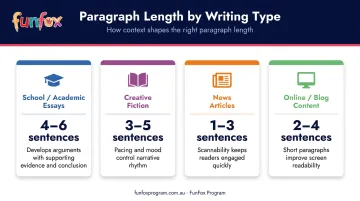
The Australian Government Style Manual recommends keeping most digital paragraphs to 2–3 sentences, with mobile content capped at 2–3 and media releases often at just 1–2. That's a long way from the structured paragraphs expected in a Year 6 persuasive essay — which is exactly why context matters more than any fixed sentence count.
What This Means for Primary School Students
For children in Australian schools, context is set by the teacher's brief. A narrative writing task follows different conventions from an informational report. Understanding why the paragraph looks different in each case — not just memorising a sentence count — is what builds genuine writing ability.
When a child writes a one-line paragraph of dialogue in a story, that's correct. When they write a one-line paragraph in an essay, that's underdeveloped. Same length, completely different result — because the judgement depends on purpose, not word count. Teaching students to ask "what does this paragraph need to do?" is far more useful than handing them a number to hit.
The Building Blocks of a Strong Paragraph
Whatever the word count, strong paragraphs share the same internal logic. Teaching children this structure gives them a framework that works across every genre.
Topic Sentence
The topic sentence is the paragraph's controlling idea. Every other sentence in the paragraph must connect back to it. If a sentence doesn't support the topic sentence, it belongs in a different paragraph entirely.
A clear topic sentence also works as the writer's own check. Ask: "What is this paragraph actually about?" If that's hard to answer, the paragraph needs rethinking — not more sentences.
Supporting Sentences
Supporting sentences answer the "how?" or "why?" raised by the topic sentence. Strong supporting sentences use:
- Specific examples ("For instance, when...")
- Evidence or facts ("Research shows that...")
- Explanation of why the example matters (not just restating it)
The most common mistake children make here is listing facts without explaining them. Three facts stacked together don't make a paragraph — they make a list.
Concluding or Linking Sentence
The final sentence does one of two things: it either wraps up the paragraph's point, or it creates a bridge to the next idea. Without it, paragraphs can feel abrupt, as though the writer lost interest halfway through.
Unity ties all three parts together. One main idea, fully developed, clearly closed. If a student reads their paragraph back and it seems to cover two separate topics, the fix is simple: split it into two paragraphs, each anchored by its own topic sentence — and suddenly both ideas get the space they deserve.
Paragraph Length Across Different Types of Writing
Academic and School Essay Writing
In structured school essays, paragraphs typically run 4–6 sentences. The length should be proportional to the essay's total scope — a short two-paragraph response needs compact, focused paragraphs, while a longer persuasive essay allows for more development within each section.
NAPLAN writing assessments, which test Years 3, 5, 7, and 9 students, assess paragraphing as a distinct criterion. The NAPLAN Narrative Writing Marking Guide values paragraphs "focused on a single idea or set of like ideas" to help readers digest chunks of text. Notably, there's no specific sentence count threshold — quality of organisation matters, not quantity of sentences.
Creative and Fiction Writing
Fiction operates by different rules entirely. Writers start a new paragraph when:
- A different character speaks (new speaker, new paragraph — always)
- The scene or location shifts
- A character moves from action to interior thought
- A single sentence creates dramatic effect on its own
Even a one-word paragraph in a short story can be the right call — it's a deliberate technique for controlling pace and emphasis.
Online and Journalistic Writing
Where fiction bends paragraph rules for effect, online writing breaks them for readability. Research from the Nielsen Norman Group found that 79% of users scan web pages rather than reading word by word. Shorter paragraphs, more white space, and tighter sentences directly improve comprehension in this environment.
That's why online writers treat every extra sentence as a reason to start a new paragraph, not finish the current one.
What Good Paragraph Writing Looks Like for Primary School Students
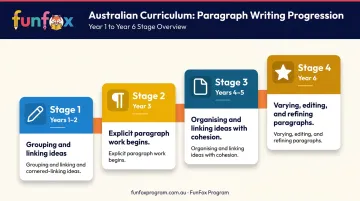
The Australian Curriculum v9 builds paragraph skills progressively. Here's what that looks like in practice:
| Year Level | Paragraph Expectation |
|---|---|
| Years 1–2 | Grouping and linking ideas using text structures; paragraph isn't the explicit focus |
| Year 3 | Explicit paragraph work begins — grouping related information, using paragraphs as organisational features |
| Years 4–5 | Using paragraphs to organise and link ideas; cohesion through referring words and linking devices |
| Year 6 | Varying paragraphs to organise, develop, and link ideas; editing and refining paragraph structure |
What a Good Year 5 Paragraph Looks Like
Here's an example of what a Year 5 persuasive paragraph looks like when it works:
Schools should have longer lunch breaks. Students who have more time to rest during the school day concentrate better in afternoon classes. For example, a study in New Zealand found that children who played freely at recess returned to class more focused and less distracted. Longer breaks also give students time to eat properly, which supports energy levels and mood. For these reasons, extending the lunch break would benefit both students and teachers.
Topic sentence. Two supporting points with a specific example. A concluding sentence that ties back to the argument. That's the structure — and it's achievable for a Year 5 student with consistent practice.
These habits become second nature with the right kind of practice. FunFox's Writers Club is built around exactly that: live weekly sessions in small groups of up to six students, where a trained teacher gives consistent, guided writing instruction until structured paragraphs stop feeling like a formula and start feeling like thinking.
Common Paragraph Mistakes Children Make (and How to Fix Them)
The List Paragraph
The most common mistake: a child strings together a series of facts with no topic sentence and no explanation.
Dogs are loyal. Dogs are friendly. Dogs help people. Dogs are popular pets.
Four sentences, but no paragraph — nothing connects or explains. The fix is to write one clear topic sentence first, then ask: "Why is this true? How does this work?" Those answers become the supporting sentences.
The Never-Ending Paragraph
Some children write one enormous paragraph because they don't know when to stop. They're not being careless — they genuinely don't know that a new idea signals a new paragraph.
Teach the one-idea rule as a practical test: "Read your paragraph back. Does it talk about more than one main thing?" If yes, find where the idea changes and break it there.
Off-Topic Sentences
Children often include sentences that feel related but actually introduce something new. The self-editing question to practise: "Does this sentence support my topic sentence?" If it doesn't, it belongs elsewhere.
Students who build this habit early find self-editing far less daunting — because they have a clear test to run, not just a vague feeling that something's off.
Frequently Asked Questions
Frequently Asked Questions
How many sentences should be in a paragraph?
Most paragraphs work well with 3–5 sentences, though up to 8 is reasonable for complex academic writing. The real guide is whether the central idea has been introduced, supported, and concluded — not whether a specific number has been hit.
How long is a one-paragraph essay?
A one-paragraph essay is typically 5–8 sentences and around 100–200 words. It still follows standard structure: a topic sentence, supporting sentences with reasoning or examples, and a brief conclusion.
Can a paragraph be just one sentence?
Yes — in journalism and fiction, a single sentence can stand alone as a paragraph for impact or pacing. In school essays, however, a one-sentence paragraph is generally considered underdeveloped, since it lacks supporting explanation or evidence.
What is the ideal paragraph length for primary school students?
For primary school students, 3–5 sentences is a practical target. Years 1–3 students typically write 2–3 sentences, while Years 4–6 students aim for 4–6 sentences covering a topic sentence, supporting details, and a conclusion.
How do I know when to start a new paragraph?
Start a new paragraph whenever the main idea changes. A simple rule for children: one idea, one paragraph. Any shift in topic, time, speaker, or argument signals it's time to start a new one.
How many paragraphs should a school essay have?
A typical primary school essay has 3–5 paragraphs: an introduction, 2–3 body paragraphs, and a conclusion. The teacher's brief is always the best guide for the specific task, so children should check assignment instructions before starting.