Persuasive writing takes that natural instinct and turns it into a curriculum skill. It's a core part of the Year 6 English syllabus, and it directly builds the muscles students need for the NAPLAN persuasive writing task they'll face in Year 7.
This article breaks down what persuasive writing actually is, the three main categories of techniques available, and how to choose and blend them so an argument actually lands.
Key Takeaways
- Language, reasoning, and structure work together to persuade readers
- Techniques split into three groups: rhetorical devices, persuasive appeals, and structure
- Rule of three and rhetorical questions offer the biggest Year 6 impact
- Strong writers blend all three categories rather than relying on one
What Is Persuasive Writing and Why Does It Matter for Year 6 Students?
Persuasive writing uses language and structure to convince a reader to agree with an opinion or take an action. It's different from narrative writing (which tells a story) or informative writing (which just presents facts) because it's arguing for something.
In the Australian Curriculum, this sits under content description AC9E6LY06. According to ACARA's Version 9.0 curriculum, Year 6 students must plan, create, edit and publish persuasive texts using paragraphs, varied sentence types, and "rhetorical devices... for persuasive effects, for an identified audience."
Here's why this matters beyond the classroom:
- Critical thinking grows when students learn to back opinions with reasoning, not just volume
- Confidence develops as students realise their point of view can genuinely change someone's mind
- High school readiness improves, since essays and debates from Year 7 onward assume these foundations are already in place
What Goes Wrong Without Technique Knowledge
Without a toolkit of techniques, persuasive writing tends to fall flat. Students state an opinion, repeat it a few times, and stop. There's no evidence, no structure, and no attempt to anticipate the other side.
The result reads like a diary entry, not an argument. A marker (or a parent, or a teacher) reads it and thinks: I see what you think, but you haven't convinced me why.
Types of Persuasive Writing Techniques
Persuasive writing isn't one skill. It's a toolkit made up of three different types of techniques, each doing a different job. The strongest pieces blend all three rather than relying on a single category.
Language and Rhetorical Techniques
This category covers word- and sentence-level devices: emotive language, rhetorical questions, repetition, alliteration, exaggeration, and the rule of three.
These devices work because they grab attention and stick in a reader's memory. Take the rule of three: grouping three words, phrases or reasons together creates rhythm, according to the Victorian Department of Education's persuasive language resource. For example:
"The new playground equipment is safe, fair, and exciting for every student."
Other examples worth knowing:
- Rhetorical question: "Should every student feel safe at school?"
- Emotive language: "No child should face a lonely, unsafe playground."
- Repetition: "We need shade. We need seats. We need action."
- Alliteration: "A safe, sunny schoolyard."
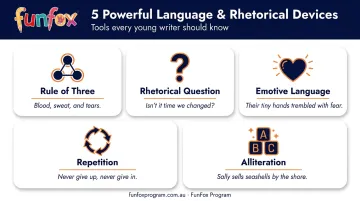
These devices operate at the word and sentence level. They don't shape the overall argument or its logic. That's a different job, covered by the other two categories.
Best suited for: speeches, adverts, persuasive letters, and the opening or closing lines of an essay, where impact matters most.
The trade-off: overusing these devices without solid reasoning underneath makes writing sound exaggerated or insincere. A rhetorical question with no evidence to follow it up feels like a gimmick, not an argument.
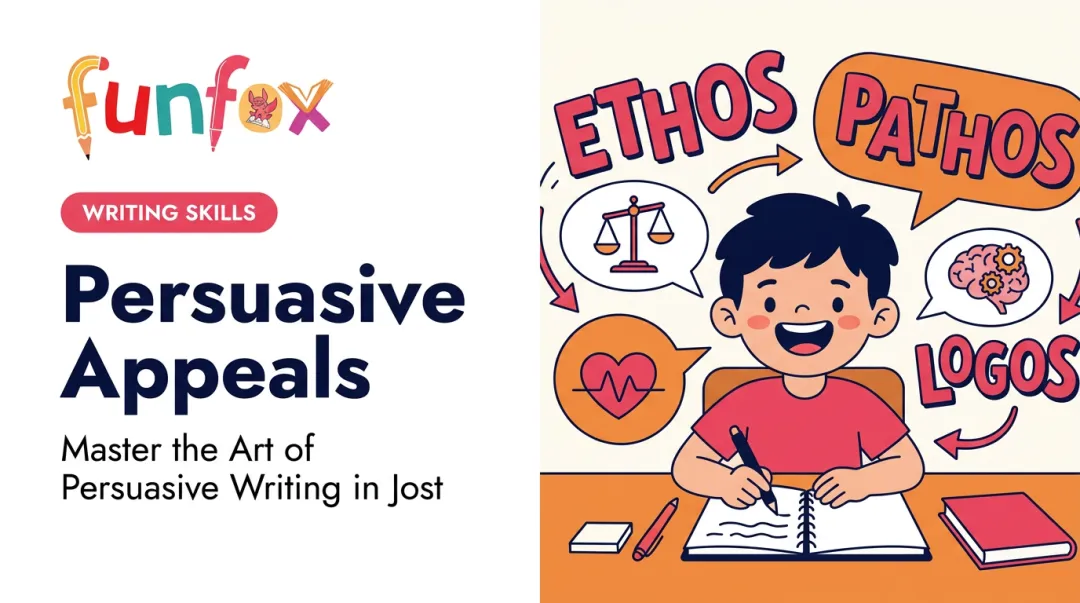
Persuasive Appeals (Ethos, Pathos, Logos)
This category is about the type of reasoning behind an argument, not the specific words used. It comes from three classical appeals, first described in Aristotle's work on rhetoric and still used in writing instruction today, per the Stanford Encyclopedia of Philosophy.
| Appeal | What it means | Year 6 example |
|---|---|---|
| Ethos | Credibility: why the writer should be trusted | "As someone who plays sport every day, I know how much shade matters at lunchtime." |
| Pathos | Emotion: how the issue makes the reader feel | "Imagine having nowhere cool to sit on the hottest day of the year." |
| Logos | Logic and facts: evidence backing the claim | "A shaded area would let both lunch groups use the space, not just one." |
Purdue OWL's guide to rhetorical strategies confirms this same three-part structure: ethical appeal, emotional appeal, and appeal to reason.
Best suited for: formal persuasive essays and debates, where a balanced, well-supported argument is expected.
The trade-off: balancing all three is genuinely hard for younger writers. Lean only on logic and the writing feels dry. Lean only on emotion, and it feels unconvincing without any evidence to hold it up.
Structural Techniques
This category covers how the piece is organised: a strong hook, TEEL or PEEL paragraph structure, addressing counterarguments, and a call-to-action conclusion.
Structure guides the reader logically from claim, to evidence, to conclusion. A typical body paragraph using PEEL might look like this:
- Point: state the claim ("The school should install more water fountains.")
- Evidence: support it with a fact or example
- Explanation: show how the evidence proves the point
- Link: connect back to the overall argument
This is different from the other two categories because it focuses on the order and connection of ideas, not word choice or reasoning type.
Best suited for: formal essays and timed writing tasks, where structure directly influences marks. NAPLAN's own Persuasive Writing Marking Guide scores text structure and paragraphing separately from persuasive devices, meaning organisation carries real weight on its own.
The trade-off: followed too rigidly, structure can feel formulaic. A perfectly labelled introduction, body and conclusion means little if the content inside is thin.
How to Choose and Combine the Right Techniques
Skilled persuasive writers don't pick one technique and stick with it. They deliberately blend categories based on purpose and audience, and Year 6 is exactly the age to start building that instinct.
A few factors shape the right mix:
- Purpose and text type — a letter, speech, and essay each need a different blend. Speeches lean harder on rhetorical devices; essays need stronger structure to hold up under scrutiny.
- Audience — writing to a teacher calls for a more formal tone and stronger logos; writing to a peer allows more emotive, conversational language.
- Topic — emotionally charged topics (like animal welfare) suit a pathos-heavy blend, while factual topics (like recycling statistics) suit logos paired with rhetorical devices.
- Task requirements — always check the specific marking criteria before finalising an approach, since some tasks reward structure more heavily than others.
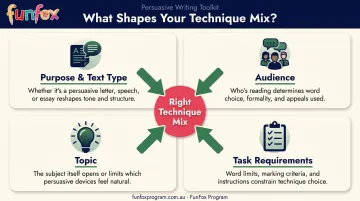
Getting this balance right isn't something most students figure out alone. It usually takes feedback, revision, and a few attempts at the same skill in different contexts.
This is where guided, small-group practice makes a real difference. In FunFox's Writers Club, Year 6 students work through persuasive writing tasks in groups of six or fewer.
A teacher who knows the technique categories can spot exactly where a piece needs adjustment:
- Too much pathos and not enough structure
- Strong logos but a flat, forgettable opening
- Good rhetorical devices without a clear argument to back them
That kind of structured, personalised feedback is hard to replicate from a worksheet alone.
Common Mistakes to Avoid
Even with good technique knowledge, a few habits consistently undercut persuasive writing:
- Relying on one category only: an essay full of emotive language but no evidence feels convincing for a sentence, then falls apart under questioning.
- Skipping counterarguments: an essay that ignores the other side reads as one-sided. NAPLAN allows one-sided arguments, but the strongest responses still acknowledge the opposing view.
- Overloading with rhetorical questions or exaggeration: three rhetorical questions in one paragraph, with no genuine explanation underneath, reads as filler rather than argument.
- Weak or absent structure: without paragraphs that build logically toward a conclusion, even good ideas get lost.
The fix for all of these is the same: pair every device with actual reasoning. A rhetorical question needs an answer. An emotive sentence needs a fact behind it.
Bringing It All Together
Persuasive writing works when language techniques, appeals, and structure pull in the same direction — no single category carries the argument alone.
Year 6 students who learn to blend rhetorical devices, ethos-pathos-logos, and clear structure — rather than relying on instinct or one favourite trick — write arguments that are genuinely harder to dismiss.
Building that instinct takes more practice than most classrooms have time for. Programs like FunFox's Writers Club give students that structured practice, with small-group feedback that turns scattered techniques into confident, exam-ready writing.
Frequently Asked Questions
What is a good persuasive topic for Year 6?
The best topics are relatable and age-appropriate, such as school rules, screen time limits, pets, or environmental issues. Students write more convincingly when they can draw on opinions and examples they already understand.
What is the rule of three in persuasive writing?
It involves grouping three words, phrases, or reasons together to create rhythm and make an argument more memorable. For example: "The plan is safe, fair, and practical."
What are the main techniques used in persuasive writing?
The main techniques fall into three categories: language and rhetorical devices (such as emotive language and repetition), persuasive appeals (ethos, pathos, logos), and structural techniques (such as PEEL paragraphs and counterarguments).
How long should a Year 6 persuasive essay be?
There's no fixed national word count. A typical structure includes an introduction, three body paragraphs, and a conclusion, but students should always check their specific task or classroom requirements.
What's the difference between persuasive and discussion writing?
Persuasive writing argues one side of an issue to convince the reader. Discussion or argumentative writing presents both sides and weighs them up before reaching a conclusion.
How can parents help their child practise persuasive writing at home?
Try mini debates over dinner, persuasive letters to family members (asking for a later bedtime, for instance), or analysing TV adverts together to spot techniques in action.