
Introduction
The letter comes home on a Tuesday. Your child bounces through the door announcing there's a spelling bee — and suddenly you're both excited and slightly panicked. Where do you even start? How do you make it fun without turning homework time into a battle?
This guide has you covered. You'll find a tiered word list organised by difficulty, practical study strategies backed by research, and fun practice activities for 7–8 year olds. There's also a section for teachers running the event.
Key Takeaways:
- Match your child to the right tier — beginner, middle, or challenge
- Practise in bee format: say the word, spell it aloud, say it again
- Group words by phonics pattern, not random order
- Short, spaced sessions over 2–3 weeks beat cramming every time
- Keep it low-stakes — confidence matters as much as accuracy at this age
What Is a 2nd Grade Spelling Bee?
A spelling bee is a structured oral competition where students take turns spelling words aloud. One word at a time, one student at a time — spell it correctly and you stay in; spell it wrong and you're out. That's the traditional format.
For 7–8 year olds, the format works best when it's adapted. Most classroom bees at this level run short rounds, use every word in a sentence, and give students time to think. Many teachers opt for non-elimination versions where every child gets multiple turns before anyone sits down. That shift in design makes the difference between a nerve-wracking test and an encouraging one.
Why Spelling Bees Work at This Age
Spelling bees build more than word memorisation. Reading Rockets explains that spelling instruction in the primary years overlaps directly with phonemic awareness — children work with sounds in spoken words and build connections between print and meaning. A well-run classroom bee practises exactly that, just with an audience.
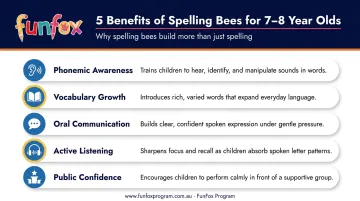
At Year 2 level, a spelling bee builds:
- Phonemic awareness through hearing, repeating, and analysing words
- Vocabulary growth through exposure to new words in context
- Oral communication practice in a structured setting
- Active listening skills as students follow along with each word carefully
- Confidence in a public, low-stakes performance setting
The key phrase is well-run. Design matters enormously at this age — the same activity can build confidence or undermine it depending on how it's structured.
The 2nd Grade Spelling Bee Word List
This list is built around the phonics patterns Year 2 students are actively working through: blends, digraphs, vowel teams, silent letters, and multi-syllable words. Words move from straightforward to genuinely challenging, so the bee tracks real progress rather than rewarding rote memorisation alone.
The list aligns with the ACARA Year 2 content descriptions for phonics and word knowledge, covering digraphs, long vowels, blends, silent letters, and one- and two-syllable words. Australian spellings are used throughout — colour, favourite, organise — with US variants noted where words differ (for example, flavour/flavor).
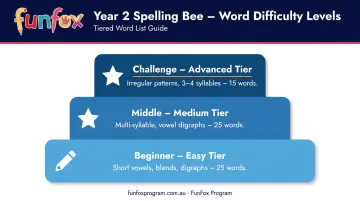
Beginner Words (Easy Tier)
These 25 words suit warm-up rounds or students still building confidence. They cover short vowels, common blends, digraphs, and high-frequency sight words.
| # | Word | Pattern Focus |
|---|---|---|
| 1 | call | short vowel + double consonant |
| 2 | fast | short vowel blend |
| 3 | glad | gl- blend |
| 4 | camp | short vowel + final blend |
| 5 | coat | oa vowel team |
| 6 | feed | ee vowel team |
| 7 | those | th digraph + split digraph |
| 8 | could | irregular sight word |
| 9 | every | two-syllable, common |
| 10 | lunch | short vowel + ch digraph |
| 11 | open | two-syllable, long vowel |
| 12 | bring | br- blend + ing |
| 13 | dark | ar vowel pattern |
| 14 | just | short vowel blend |
| 15 | much | short vowel + ch digraph |
| 16 | wash | wa- pattern |
| 17 | barn | ar vowel pattern |
| 18 | most | long vowel, common |
| 19 | class | cl- blend + double s |
| 20 | shape | sh digraph + split digraph |
| 21 | mice | soft c + split digraph |
| 22 | free | fr- blend + ee |
| 23 | away | two-syllable, ay |
| 24 | tune | split digraph |
| 25 | lock | short vowel + ck |
Middle Words (Medium Tier)
These 25 words introduce multi-syllable structures, vowel digraphs, and common irregular patterns — the heart of what Year 2 students are working through.
| # | Word | Pattern Focus |
|---|---|---|
| 1 | rabbit | short vowel + double consonant |
| 2 | basket | two-syllable, short vowels |
| 3 | pattern | two-syllable, -ern ending |
| 4 | tower | ow diphthong, two-syllable |
| 5 | dragon | dr- blend, two-syllable |
| 6 | second | two-syllable, schwa |
| 7 | morning | or pattern, two-syllable |
| 8 | cobweb | compound word |
| 9 | careful | care + ful, two-syllable |
| 10 | picture | two-syllable, -ure ending |
| 11 | window | two-syllable, ow ending |
| 12 | secret | long e, two-syllable |
| 13 | orange | or- + soft g, two-syllable |
| 14 | painter | ai vowel team + -er |
| 15 | scratch | scr- blend + tch |
| 16 | everyone | three-syllable, compound |
| 17 | together | three-syllable, common |
| 18 | airplane | ai vowel team, compound |
| 19 | cherries | ch digraph + -ies ending |
| 20 | flavour | two-syllable (US: flavor) |
| 21 | knock | silent k, ck ending |
| 22 | lucky | two-syllable, short vowel + y |
| 23 | puddle | two-syllable, double d |
| 24 | river | two-syllable, short vowel |
| 25 | recess | two-syllable, double s |
Challenge Words (Advanced Tier)
These 15 words are for strong spellers or final rounds. They include irregular patterns, three-syllable words, and less predictable grapheme-phoneme combinations.
| # | Word | Pattern Focus |
|---|---|---|
| 1 | unicorn | three-syllable, long u |
| 2 | dinosaur | three-syllable, irregular -aur |
| 3 | toothpaste | oo vowel team, compound |
| 4 | biscuit | irregular -uit ending |
| 5 | accident | three-syllable, double c |
| 6 | janitor | three-syllable, schwa |
| 7 | mysterious | four-syllable, -ious ending |
| 8 | fascinating | four-syllable, soft c |
| 9 | zipped | short vowel + double p + ed |
| 10 | bushes | ush + -es |
| 11 | itself | compound, short vowels |
| 12 | young | irregular vowel pattern |
| 13 | early | ear- irregular vowel |
| 14 | until | two-syllable, short vowels |
| 15 | crystal | cr- blend, three-syllable |
📥 Download the printable PDF of this complete word list — formatted for home study and classroom use.
How to Help Your Child Study the Spelling Bee List
The single most common mistake in spelling bee prep is treating it like a writing exercise. Spelling bees are oral — your child needs to practise hearing the word, saying it back, spelling it aloud, and saying it again. Writing lists on paper is helpful, but it won't prepare them for standing at the front of the room.
The Say-Spell-Say Method
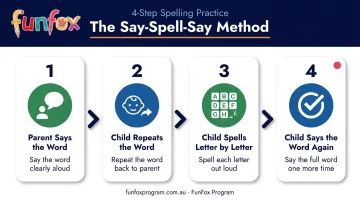
This is the standard bee protocol, and it's worth practising from day one:
- Parent says the word (and uses it in a sentence)
- Child repeats the word aloud
- Child spells it letter by letter — no rushing
- Child says the word again to close
It sounds simple, but the rhythm of it takes practice. Children who've only written their words often freeze when asked to spell aloud under time pressure. Do this daily, even for just five minutes.
Study by Pattern, Not by List Order
Research from Reading Rockets shows that children learn spelling far more effectively when they compare words within the same pattern rather than memorising unrelated words one by one. Instead of working through the full list alphabetically, group words:
- All silent-k words together: knock, kneel, knot
- All -ck endings: lock, duck, quick
- All two-syllable words with double consonants: rabbit, puddle, lucky
When a child understands the rule behind the pattern, they can apply it to new words — which matters if they hit an unfamiliar word during the bee.
Space It Out Over 2–3 Weeks
Research on primary school vocabulary learning consistently shows that spaced practice outperforms cramming. Goossens et al. found that children who learned with spaced repetition retained word meanings significantly better at one-week and five-week follow-ups compared to children who studied in cramming sessions.
In practice, that means:
- 5–8 words per day, not 25 in one sitting
- Revisit the previous day's words before introducing new ones
- Mix in words from earlier in the week on review days
- Keep sessions short — 10–15 minutes is plenty for a 7–8 year old
Parents looking to build these skills more systematically beyond bee prep may find FunFox's Foundation Club useful — it's designed specifically for Year 1–2 students, combining reading and writing in live, small-group online sessions (maximum 6 students) aligned to the Australian curriculum.
Always Use Context Sentences
In an actual spelling bee, the pronouncer always reads the word in a sentence. Practise this at home too. When your child hears "The biscuit was crumbly and sweet — biscuit," they connect the spelling to meaning. That connection strengthens retention and builds vocabulary at the same time.
Fun Spelling Bee Practice Activities for 2nd Graders
Drilling word lists gets old fast. These activities keep the practice feeling like play rather than homework.
Mock Spelling Bee at Home
Stand your child up (this matters, since their body needs to know the physical experience before the real thing). You be the pronouncer: say the word, use it in a sentence, then wait. Let them repeat it, spell it aloud, and say it again. Keep it low-key — cheer the correct ones and move on from the wrong ones without drama.
Even one round of 10 words per day makes a difference.
Hands-On Word Building
- Magnetic letters on the fridge — you call a word, they build it
- Letter tiles on the floor — physically arrange letters, works well for kinaesthetic learners
- Whiteboard race — parent and child both try to write the word, compare spellings together (not a test, just fun)
Word Sorting Games
Write every word on a separate card. Then ask your child to sort them by:
- Number of syllables (1 / 2 / 3+)
- Starting letter
- Phonics pattern (words with oo, words with silent letters, etc.)
Sorting forces active engagement with each word's structure — and most kids find it far more enjoyable than reading a list.
Tips for Running a 2nd Grade Spelling Bee
Before the Event
- Share the full word list with students and families at least two weeks before the bee
- Use sentences for every word during the actual competition — this is standard bee protocol and helps reduce anxiety
- Tell students in advance that they can ask for: a repetition of the word, the word in a sentence, or the definition — these are all legitimate requests in a real spelling bee format
On the Day
Keep the format age-appropriate. Research on classroom competition at primary school level shows it can increase engagement but can also raise learning anxiety, and the two effects often work against each other for younger students. For Year 2, consider:
- Non-elimination warm-up rounds where everyone gets 2–3 turns before any elimination begins
- Team-based formats where students support each other rather than competing individually
- A final individual round only for students who want to participate in it
Recognising Every Participant
The format you choose matters, but so does how every child leaves the room feeling. Certificates, stickers, and class acknowledgement for every speller — not just the winner.
At this age, the goal is building a positive association with spelling and language. A child who spells "rabbit" in front of the class and walks away proud is far more likely to enjoy reading and writing long-term than one who was eliminated in round one and hasn't quite recovered from it.
Frequently Asked Questions
What is a spelling bee for class 2?
A class 2 spelling bee is an oral competition where students take turns spelling age-appropriate words aloud from a grade-level list. The primary purpose is to build vocabulary, phonics skills, and spoken confidence in a structured but supportive setting — competition is secondary to participation at this level.
How many words should a 2nd grade spelling bee have?
Scripps publishes 50 challenging second-grade words as a benchmark for classroom bees at this level. Most teachers share a longer study list (50–100 words) for home preparation, then use a shorter set of 25–30 words for the actual competition rounds.
How do I help my child study for a 2nd grade spelling bee?
Practise in the real format — say it aloud, spell it aloud, say it again. Break the list into small daily chunks of 5–8 words, group words by phonics pattern, and use hands-on games to keep motivation up.
What phonics skills does a 2nd grade spelling bee test?
Year 2 bee words typically test blends (dr-, fl-, scr-), digraphs (sh, ch, th), vowel teams (ai, oa, ee), silent letters (knock, wrap), and simple multi-syllable words.
When do spelling bees typically happen in 2nd grade?
Classroom spelling bees can run at any point, but are most common in the second half of the school year — Terms 3–4 in Australian schools — when students have built stronger phonics knowledge and vocabulary.
Are 2nd grade spelling bee words different in Australia compared to the US?
The core phonics patterns and difficulty levels are very similar. The main difference is spelling conventions: Australian English uses colour, favourite, organise, and centre where American English uses color, favorite, organize, and center. This list uses Australian spellings throughout, making it classroom-ready for Australian teachers and families.