Introduction
Picture this: a student sits at a desk, staring at a blank page. The prompt reads, "Describe a place that matters to you." Nothing comes out, not because the student lacks a memory, but because they don't know how to turn it into words that make a reader feel something.
This is one of the most common creative writing tasks assigned from upper primary school onward, and many students approach it without a clear plan.
This guide covers everything you need:
- The five key elements of strong descriptive writing
- A clear introduction–body–conclusion structure
- A ready-to-use outline template with a sample filled-in version
- Organisation strategies and practical writing tips
By the end, you'll know how to plan, structure, and write a descriptive essay that engages the reader's senses and earns strong marks.
Key Takeaways
- A descriptive essay creates a vivid impression through sensory language and figurative devices, not just information
- Strong essays follow a three-part structure: introduction, body paragraphs, conclusion
- Every detail should support one central feeling, called the dominant impression
- The PEEL method keeps body paragraphs focused and clearly structured for marking
- A five-paragraph template scales from 400 to 1,500 words
What Is a Descriptive Essay?
As Reading Rockets defines it, descriptive writing aims to describe a person, place, or thing "in such a way that a picture is formed in the reader's mind," using details and all five senses. The goal is not to inform or argue — it's to make the reader feel as though they are there.
That distinction matters, because descriptive writing follows different rules than the essay types students encounter most often in school.
How It Differs from Other Essay Types
| Essay Type | Primary Purpose |
|---|---|
| Descriptive | Create a vivid sensory impression of a subject |
| Narrative | Tell a story with a plot arc (beginning, conflict, resolution) |
| Argumentative | Persuade the reader using evidence and reasoning |
A descriptive essay doesn't need a plot or a thesis you're defending. It needs one clear, dominant mood and the sensory details to sustain it — which is harder than it sounds when the only tool you have is language.
The 5 Key Elements of Descriptive Writing
1. Sensory Details
Strong descriptive writing puts the reader inside the experience. That means engaging all five senses: sight, sound, smell, touch, and taste.
Compare these two sentences:
- ❌ "The coffee was hot."
- ✅ "Steam curled from the mug, and the bitter warmth settled in my throat."
The second version gives the reader something to feel, not just a fact to file away.
2. Figurative Language
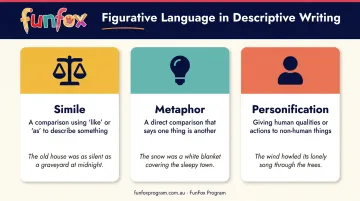
The Australian Curriculum expects students from Year 5 onward to experiment with figurative language in literary texts (AC9E5LE05). The three types that appear most often in descriptive writing are:
- Simile — comparison using "like" or "as": The fog moved like a slow tide across the lawn.
- Metaphor — direct comparison: The forest was a cathedral, silent and vast.
- Personification — giving human qualities to non-human things: The wind complained through the gaps in the fence.
3. Show, Don't Tell
This is the golden rule. Instead of stating an emotion directly ("she was nervous"), show it through physical detail and action:
She twisted the hem of her jumper and kept glancing at the door.
The reader draws their own conclusion, which makes the feeling land harder. The National Children's Book and Literacy Alliance's 2024 educator guide frames this as using "concrete details, actions, and sensory information rather than direct statement."
4. Precise Word Choice
Vague words — nice, bad, big, walked — do the minimum. Precise words do the work:
- "walked" → trudged, paced, wandered, slipped
- "big" → towering, sprawling, hulking
One caution: don't reach for a thesaurus for every word. If a substitution sounds unnatural, it pulls the reader out of the moment.
5. Dominant Impression
Every descriptive essay needs one clear, overriding mood or feeling — what Writing@CSU calls a single dominant impression. Your thesis names it. Every detail you include supports it.
For example: an essay about a storm might aim for overwhelming power and wildness. A detail about sunlight filtering through curtains would undercut that — leave it out.
Descriptive Essay Structure: Introduction, Body, and Conclusion
A descriptive essay follows the same three-part shape as most essays. Think of the proportions this way:
- Introduction: 10–15% of the total word count
- Body paragraphs: 70–80%
- Conclusion: 10–15%
This structure keeps the writing focused and guides the reader through the description without getting lost.
Crafting the Introduction
A strong descriptive introduction has three components:
- Hook — An immediate sensory detail or striking image that drops the reader into the scene. The smell hit me first: salt and old timber and something faintly sweet.
- Brief context — One or two sentences introducing the subject. Every summer holiday ended at this wharf.
- Dominant impression statement — Signals the overall mood the essay will create. This is the place where time seemed to slow down and the world felt smaller, in the best possible way.
Avoid starting with a dictionary definition or a broad generalisation. Both are weak openings that lose the reader before you've started.
Writing the Body Paragraphs
Each body paragraph focuses on one aspect of the subject. Use this internal structure:
- Topic sentence — What this paragraph is describing
- Three to five sensory details — The evidence
- Brief analysis — How these details reinforce the dominant impression
- Transition — A bridge to the next paragraph
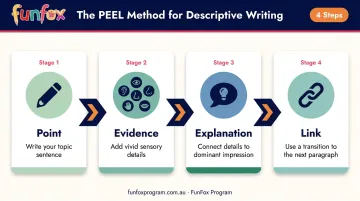
The PEEL method (Point, Evidence, Explanation, Link) fits this structure well. As NSW Department of Education materials describe it, PEEL provides "a structure for writing clear and focused paragraphs." Applied to descriptive writing:
- Start with a topic sentence that names the single aspect you're describing (Point)
- Follow with three to five sensory details — what you saw, heard, smelled, felt, or tasted (Evidence)
- Explain how those details build the dominant impression you're creating (Explanation)
- Close with a transition sentence that carries the reader naturally into the next paragraph (Link)
Writing the Conclusion
The conclusion has two jobs:
- Reinforce the dominant impression — but in fresh wording, not a word-for-word repeat of the introduction
- Leave a final sensory image or reflection — something that lingers
What to avoid: introducing new details the essay hasn't prepared the reader for, or summarising mechanically ("In conclusion, I have described..."). A strong conclusion returns to the emotional core — something like Standing there one last time, I understood that the wharf hadn't changed. I had. That's the kind of ending that stays with a reader long after the essay is finished.
Ready-to-Use Descriptive Essay Outline Template
The Basic Template
INTRODUCTION
Hook: [An immediate sensory detail or image]
Context: [1–2 sentences introducing the subject]
Dominant Impression: [The overall feeling the essay will create]

BODY PARAGRAPH 1
Topic Sentence: [What aspect are you describing?]
Sensory Detail 1: [Sight/sound/smell/touch/taste]
Sensory Detail 2:
Sensory Detail 3:
Connection: [How do these details reinforce the dominant impression?]
Transition: [Lead into Paragraph 2]

BODY PARAGRAPH 2
[Same structure — different aspect of the subject]

BODY PARAGRAPH 3
[Same structure — different aspect of the subject]

CONCLUSION
Reinforce Impression: [Fresh wording, not a copy of the intro]
Final Sensory Image: [Something that creates a lasting emotional effect]
This five-paragraph structure works for essays from 400 to 1,500 words — you simply expand or condense the sensory details per paragraph to match the required length.
The template adapts easily depending on what you're describing. Here's how to adjust your approach by subject type:
Adapting the Template by Subject Type
- Place description: Organise spatially — entrance to corner, floor to ceiling, near to far
- Person description: Move from outer appearance → behaviour → emotional impression
- Experience description: Follow a chronological arc from beginning to end
To see how this looks in practice, here's a complete filled-in outline using a familiar subject.
Sample Filled-In Outline: "A Favourite Place in Nature"
Introduction
- Hook: The river was always colder than expected — sharp enough to make you catch your breath
- Context: A bend in the creek at the edge of my grandparents' property
- Dominant Impression: Stillness, wildness, the feeling of being genuinely far from everything
Body Paragraph 1 — Sound and Atmosphere
- The rush of water over smooth stones
- Distant birdcalls, then silence
- Wind moving through the gum leaves above
- Connection: These sounds build the feeling of isolation and quiet power
Body Paragraph 2 — Sight and Texture
- Light breaking through the canopy in long shafts
- Moss-covered rocks, slippery underfoot
- The creek running clear over dark mud and pebbles
- Connection: Visual details reinforce the sense of untouched wildness
Body Paragraph 3 — Smell and Temperature
- Eucalyptus and wet earth after rain
- Cool air sitting low above the water
- The sharp smell of clean mud on your hands
- Connection: These physical sensations deepen the dominant impression of rawness and calm
Conclusion
- Reinforce: There was nowhere else that felt so completely separate from ordinary life
- Final Image: Standing still in the current, cold water around your ankles, the world reduced to this
Word-Count Budgeting
For a 600-word essay:
- Introduction: 60–90 words
- Each body paragraph: 130–160 words
- Conclusion: 60–90 words
For longer essays, keep the same five-paragraph structure. Add depth through more specific sensory details, not extra paragraphs.
How to Organise Your Descriptive Essay
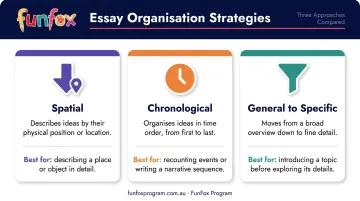
Three organisation strategies work well for descriptive writing, and the right choice depends on your subject:
Spatial — Details arranged by physical location (top to bottom, near to far, left to right). Best for describing a place or object. Example: starting at the entrance of a market and moving deeper into the crowd.
Chronological — Details follow the order they happened in time. Most effective for describing an experience or event. Example: arriving at the market as stalls open, moving through it at noon, leaving as it quietens.
General to specific — Begin with a broad overall impression and narrow to fine details. Works for any subject type and is often the easiest starting point for students who aren't sure where to begin.
When in doubt, general to specific is a reliable default. Start with the big picture so your reader knows where they are, then zoom in on the details that make your description come alive.
Tips for Writing a Standout Descriptive Essay
Ditch the Clichés
"Cold as ice," "heart of gold," "the time of my life" — these phrases have been used so often they've lost all impact. Markers notice them too. Replace worn-out comparisons with specific, original descriptions that reflect your own perspective.
Run a Sensory Checklist Before You Draft
Before writing a single sentence, brainstorm two to three details per relevant sense. This prewriting step ensures your body paragraphs draw on varied senses rather than relying almost entirely on visual description (the most common beginner habit). Taste won't always be relevant — and that's fine. But sound, smell, and touch often get neglected, and they're frequently the most evocative.
Build the Skill Consistently
One of the hardest things about descriptive writing is that knowing the rules and applying them under pressure are two different things. Students who practise regularly improve noticeably faster than those who only write when a task requires it. Working through different subjects, seeking feedback, and experimenting with figurative language all accelerate that growth.
For primary school students who need that regular, structured practice, FunFox Program's Writers Club provides live online small-group sessions with personalised teacher feedback between classes — keeping students writing and improving throughout the term.
Frequently Asked Questions
What are the 5 elements of descriptive writing?
The five core elements are: sensory details (sight, sound, smell, touch, taste), figurative language (simile, metaphor, personification), precise word choice, the show-don't-tell principle, and a dominant impression that unifies the whole essay. Strong descriptive writing uses all five in combination, not isolation.
What is the structure of a descriptive essay?
A descriptive essay follows three parts: an introduction (hook, context, dominant impression statement), body paragraphs (each covering one aspect using sensory details), and a conclusion (a final sensory image that reinforces the dominant impression). Five paragraphs is the most common format.
How do you start a descriptive essay introduction?
Begin with an immediate sensory hook that drops the reader into the scene, then add one or two sentences of context. Close with a dominant impression statement that signals the overall mood. Avoid opening with definitions or generalisations — concrete detail works far better.
What is the difference between a descriptive essay and a narrative essay?
A narrative essay tells a complete story with a clear arc (beginning, conflict, resolution). A descriptive essay focuses purely on evoking a vivid impression of a person, place, object, or experience through sensory language. It doesn't need a plot; it needs a dominant feeling.
How long should a descriptive essay be?
Length varies by stage: primary school essays are often 300–500 words, high school tasks typically range from 500–800 words, and university-level tasks can reach 1,000–1,500 words. The five-paragraph structure scales to any of these lengths.
What are good descriptive essay topics for primary school students?
Strong topics include a favourite place at home or school, a memorable meal, a special object (a toy, book, or gift), a season or weather event, or a person who matters to them. The best topics are ones students know well — specific sensory details come naturally when the subject is familiar.