Introduction
Something shifts in Year 2 that most parents don't see coming. Up until this point, learning to read has largely meant cracking the code — sounding out words, recognising high-frequency sight words, building fluency. Year 2 is where the goalposts move. Children are now expected to read to learn, and that means comprehension — not decoding — becomes the central skill.
The problem? Walk into any teacher supply store or browse online, and you'll find hundreds of worksheets claiming to be perfect for Year 2. Without knowing what to look for, it's genuinely difficult to separate the ones that build real skills from the ones that just keep kids busy.
This guide cuts through that confusion. It covers what the Australian Curriculum expects of Year 2 readers and the specific comprehension skills worth practising. You'll also find the worksheet types that deliver results — and how to make home practice genuinely productive, not just something to tick off before dinner.
Key Takeaways:
- Year 2 is the first year Australian students are formally expected to make inferences from text
- Strong comprehension now directly shapes NAPLAN readiness and long-term academic outcomes
- Effective worksheets combine literal recall, inferential questions, and vocabulary tasks
- Short, regular practice (3–4 sessions per week) outperforms occasional lengthy study sessions
- When worksheets aren't enough, structured instruction with teacher feedback closes the gap
What the Australian Curriculum Expects From Year 2 Readers
Moving Beyond Decoding
The Australian Curriculum v9.0 English content descriptor AC9E2LY05 is direct: Year 2 students must "use comprehension strategies such as visualising, predicting, connecting, summarising, monitoring and questioning to build literal and inferred meaning". By the end of Year 2, ACARA's achievement standard expects students to read and comprehend texts by identifying both literal and inferred meaning, and to discuss how ideas are presented through characters and events.
In plain terms, a child working at the Year 2 standard can:
- Retell a short story with the events in the right order
- Answer "who," "what," and "where" questions accurately from a text
- Begin to answer "why" and "how" questions — with some support
- Discuss characters and settings and give reasons for their preferences
- Read and respond to both narrative and informational texts
This is a meaningful step up from Year 1, where the focus sits heavily on phonics and word recognition. In Year 2, comprehension shifts from background skill to the centrepiece of English instruction.
Why This Year Matters for Long-Term Outcomes
That shift in instructional priority has real consequences for where students end up years later. Research from the Grattan Institute's 2024 Reading Guarantee report found that disadvantaged Year 3 students were already at least one year behind their more advantaged peers in reading — and that gap widened to more than five years by Year 9. The pattern is clear: gaps that open early compound over time.
Year 2 is also the year directly preceding NAPLAN. Australian students sit their first formal national assessment in Year 3, which includes a reading component. The comprehension skills students build in Year 2 are precisely what NAPLAN's Year 3 reading component assesses.
The Comprehension Skills Good Year 2 Worksheets Should Build
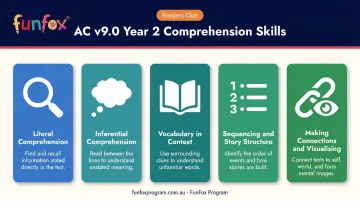
Not all worksheets practise the same skills. The best ones target these five areas deliberately:
Literal Comprehension
These are the "find it in the text" questions: What was the character's name? Where did the story take place? They're not trivial — they anchor children in the text and confirm basic understanding before any deeper work begins. Every worksheet should include at least a few of these.
Inferential Comprehension
This is where Year 2 gets most demanding. Inferential questions ask children to work out meaning that isn't directly stated. For 6–7 year olds, this stretches working memory considerably. Common examples include:
- How do you think the character felt?
- What clues in the text helped you decide?
Scaffolded tasks — prompts that guide rather than simply ask — make this manageable.
Vocabulary in Context
Quality worksheets embed unfamiliar words in a passage and ask children to use surrounding sentences to work out meaning. This approach builds comprehension and vocabulary at the same time, which matters because vocabulary knowledge is a core component of language comprehension according to AERO's Introduction to the Science of Reading.
Sequencing and Story Structure
Worksheets that ask children to order events, complete a beginning–middle–end story map, or identify the problem and solution help them grasp narrative structure. ACARA's formative assessment guidance identifies sequencing as a recognised comprehension question type — and the skills transfer directly into more organised written responses.
Making Connections and Visualising
Both strategies — connecting text to personal experience and forming a mental image of what's been read — are named explicitly in AC9E2LY05. Worksheets that prompt children to draw what they pictured, or to write one sentence connecting the story to their own life, tend to stick longer in memory than straightforward recall questions.
Types of Year 2 Reading Comprehension Worksheets Worth Using
Fiction Passage Worksheets
Short stories, fables, and picture book excerpts work well at Year 2 level. A good fiction worksheet includes:
- A passage of 1–2 paragraphs at the appropriate reading level
- A mix of literal and inferential questions
- At least one vocabulary task
Fables are particularly effective because they carry a moral — children have to think beyond what happened to what it means, which is genuine comprehension work. A 2015 peer-reviewed study found that children's ability to extract lessons from fables develops alongside reading comprehension and theory of mind, making them a well-suited genre for this age group.
Nonfiction and Informational Text Worksheets
The Australian Curriculum explicitly requires Year 2 students to read and respond to informational texts, not just stories. A well-designed nonfiction worksheet for Year 2 includes:
- A short passage on a concrete, accessible topic (animals, weather, community helpers)
- Fact-based retrieval questions
- A task asking the student to identify the main idea in their own words
Parents often default to fiction worksheets because they feel more engaging. Nonfiction practice matters just as much — these are the kinds of texts children meet in science units, library research tasks, and NAPLAN reading passages.
Sequencing and Story Map Activities
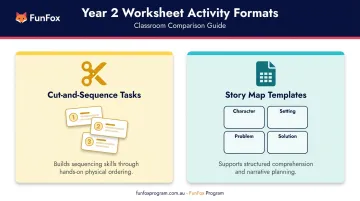
These activities bridge the gap between understanding a story and being able to organise that understanding on paper — a very common challenge at Year 2. Two formats work especially well:
- Cut-and-sequence tasks: scrambled story events that children physically order, supporting visual learners and logical sequencing
- Story map templates: structured spaces for character, setting, problem, and solution, helping children who can retell a story verbally but struggle to get it down in writing
Cloze Activities
Fill-in-the-blank passages require children to read for meaning at the sentence level, selecting a word that makes sense in context. For Year 2, cloze tasks work best when a word bank is provided — this keeps the focus on meaning-making rather than word retrieval, so children focus on understanding context rather than trying to recall vocabulary from memory.
What to Look for When Choosing Year 2 Worksheets
Reading Level Match
A passage that's too difficult produces frustration, not comprehension practice. Look for worksheets that specify a year level or reading level, then do a check: can your child read the passage aloud with minimal help? If they're struggling with more than a word or two per sentence, the passage is too hard for comprehension work.
A Balance of Question Types
High-quality worksheets mix:
- Multiple choice — lower cognitive load, good for starting out
- Short written answers — require the child to locate and record information
- Open-ended or "explain your thinking" questions — build analytical reasoning
Worksheets that rely only on tick-box formats don't develop the thinking Year 2 comprehension demands — children need practice expressing understanding in words, not just selecting from options.
Curriculum Alignment
Generic worksheets from overseas sites often use different terminology, unfamiliar contexts, or assessment frameworks that don't match what Australian teachers expect. Worksheets produced by Australian educational publishers or referencing the AC v9.0 English descriptors are a safer choice — check that the text types and question styles align with what ACARA describes for Year 2 English.
Tips for Making Worksheet Practice Productive at Home
How you use a worksheet matters as much as which one you choose. These three habits make a noticeable difference.
Keep sessions short and regular. AERO's spacing and retrieval practice guide confirms that spacing learning across multiple shorter sessions improves long-term retention more than massed practice. Three to four 10–15 minute sessions per week will serve your child better than a lengthy Saturday session.
Read together before attempting questions. Read the passage aloud together first, then have your child read it independently before tackling the questions. This mirrors what NSW's gradual release of responsibility model recommends — modelling, then guided practice, then independent work — and removes the pressure of answering questions cold.
Turn the debrief into a conversation. When reviewing answers, ask "What made you think that?" rather than simply marking right or wrong. This shifts the worksheet from a test into a discussion, and practising how to explain and defend comprehension is a skill that pays off throughout schooling.
When Worksheets Alone Aren't Enough
Worksheets are a practice tool, not an instructional one. They're most effective when a child already has the underlying strategy and just needs repetition to consolidate it.
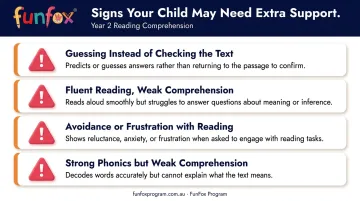
Watch for these warning signs that your child may need more than worksheet practice:
- Consistently guessing at comprehension questions rather than returning to the text
- Reading fluently but unable to answer basic questions about what they've read
- Avoiding reading tasks or showing frustration when asked to explain what they've read
- Performing well on phonics assessments but struggling with meaning
These patterns can reflect what's sometimes called the "word caller" phenomenon — a child whose decoding is strong but whose language comprehension hasn't kept pace. The Simple View of Reading explains why: word recognition and language comprehension are separate skills, and strong decoding doesn't guarantee strong comprehension. These children need explicit strategy instruction, not more of the same worksheet practice.
For Year 2 students who've hit this ceiling, the FunFox Foundation Club offers a structured alternative. Designed specifically for Years 1 and 2, it combines guided reading and comprehension development with writing instruction in weekly one-hour live online sessions with a maximum of six students per class.
Teachers are trained in the FunFox Way and deliver live, interactive instruction focused on building genuine comprehension skills. Because classes run via Zoom, families can access consistent support regardless of location.
Frequently Asked Questions
What reading comprehension skills should a Year 2 student have in Australia?
By the end of Year 2, students should be able to recall facts from a text, retell events in sequence, identify characters and settings, make simple inferences, and begin identifying the main idea. These expectations come directly from ACARA's v9.0 Year 2 English achievement standard.
How often should Year 2 students practise reading comprehension worksheets?
Three to four short sessions per week — around 10–15 minutes each — is more effective than infrequent intensive sessions. Regular, low-pressure practice builds stronger comprehension habits than cramming.
What types of texts are best for Year 2 reading comprehension worksheets?
A mix of fiction (short stories, fables) and nonfiction (simple informational passages on concrete topics) is ideal. The Australian Curriculum requires competency across both text types, so practising only one leaves a gap.
How do I know if my child is struggling with reading comprehension in Year 2?
Key signs include difficulty retelling what they've just read, consistently picking random answers, reading fluently but unable to answer questions about meaning, and avoiding reading activities.
What is the difference between literal and inferential comprehension for Year 2?
Literal comprehension means finding information explicitly stated in the text. Inferential comprehension means working out meaning that is implied but not directly written. Year 2 is when Australian students formally begin practising both.
Are free Year 2 reading comprehension worksheets as effective as paid ones?
Free worksheets from curriculum-aligned Australian sources can be just as effective as paid ones — provided they target the right skills, use appropriate text types, and align to the AC v9.0 Year 2 English expectations.