Many parents notice this shift and reach for worksheets. That's a reasonable instinct — but which worksheets, and how you use them, matters far more than simply doing them.
This guide covers what comprehension skills actually matter at Year 7, what separates a useful worksheet from a forgettable one, and how to make home practice genuinely effective.
Key Takeaways
- Year 7 students must master five core skills: inference, main idea, author's purpose, vocabulary in context, and summarising
- Quality worksheets use tiered questions — literal, inferential, and evaluative — alongside a writing response component
- Active reading strategies (annotating, predicting, questioning) consistently outperform passive reading
- Short, consistent practice beats occasional long sessions for building comprehension fluency
- When gaps are significant, structured small-group programs offer the guided feedback worksheets cannot provide
Why Reading Comprehension Becomes More Challenging in Year 7
The difficulty isn't just that texts get longer. The cognitive demands shift entirely.
ACARA's Version 9 curriculum for Year 7 English requires students to engage with media texts, novels, non-fiction, film, poetry, and dramatic performances simultaneously — each demanding different reading strategies. Students must predict, connect, question, infer, summarise, and monitor their own understanding.
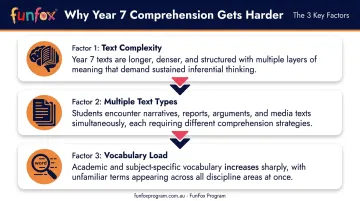
Three factors drive the difficulty spike:
- Text complexity: Passages no longer deliver meaning on the surface. Students must read between the lines, use prior knowledge, and hold multiple ideas in working memory at once
- Multiple text types: Literary, informational, and persuasive texts each require a different reading approach, and Year 7 introduces all three in rapid succession
- Vocabulary load: ACARA explicitly requires Year 7 students to investigate specialist and technical vocabulary, including words that carry both everyday and subject-specific meanings — across English, Science, History, and Geography simultaneously
Australia's PISA 2022 results showed a 30-point drop in reading scores from 2000 to 2022 among 15-year-olds, pointing to a literacy decline that starts well before senior school. Year 7 is often where that gap first opens.
Key Reading Comprehension Skills Year 7 Students Need to Master
Before choosing or creating worksheets, understand what skills they should target. A worksheet that only asks recall questions is not building comprehension — it's testing memory. ACARA and NAPLAN proficiency descriptors point clearly to five skills that matter most at this level.
Identifying Main Idea and Supporting Details
At Year 7, finding the main idea means more than reading the first sentence of a paragraph. Students need to understand how authors structure support for a central claim — through evidence, examples, and paragraph organisation.
Many worksheets stop at "What is this passage about?" Strong worksheets ask students to identify the main idea and explain which details support it — two very different cognitive demands.
Making Inferences and Drawing Conclusions
Inference means using clues in the text plus background knowledge to reach a conclusion the author never states directly. NAPLAN proficiency descriptors show that "Strong" Year 7 readers can connect ideas across different parts of a text to make inferences — while students at the "Needs Additional Support" level struggle to locate even clearly stated information. Worksheets that sequence inference tasks from single-paragraph clues up to whole-text connections are the most effective way to build this skill deliberately.
Identifying Author's Purpose and Point of View
Students must distinguish between texts written to inform, persuade, or entertain — and then go further, identifying how word choices reveal an author's perspective. ACARA names this for Year 7: students analyse how language varies by audience and purpose, and how visual techniques create perspective. Asking "Is this informative or persuasive?" misses the point. The real task is explaining how word choices and structure work together to achieve that purpose.
Vocabulary in Context
Vocabulary in context means using surrounding sentences — and sometimes the structure of an unfamiliar word itself — to determine meaning, not memorising definitions. This matters especially for figurative language and domain-specific terms that shift across subjects. The key test: can the student explain how they worked out the meaning, not just what it is?
Summarising and Synthesising
Summarising means condensing what a text actually says. Synthesising means connecting ideas — across paragraphs, or across multiple texts. ACARA expects Year 7 students to analyse and summarise information, and evaluate ideas across sources. Strong worksheets scaffold from one to the other: start with "What does this paragraph say?" and build toward "How does this author's argument compare with the one you read earlier?"
What Makes a High-Quality Year 7 Reading Comprehension Worksheet
Not all worksheets are worth your child's time. Here's what separates useful ones from time-fillers.
The Four Components of a Strong Worksheet
A well-designed Year 7 comprehension worksheet includes:
- A year-level-appropriate passage — complex enough to challenge, but not so dense it shuts comprehension down before it starts
- A vocabulary task — requiring students to use context clues, not a dictionary
- A tiered question set — moving from literal recall through to inference and evaluation
- A writing extension prompt — asking students to respond, form an opinion, or continue a line of thinking
What Good Questions Look Like
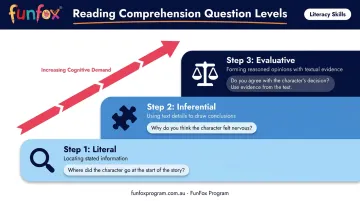
Tiered questions should progress in difficulty:
- Literal: "According to the text, what happened when...?" (locating stated information)
- Inferential: "What does the author suggest about...? Use details from the passage to support your answer."
- Evaluative: "Do you agree with the author's position? Explain your reasoning using evidence from the text."
A worksheet that stops at literal questions isn't building comprehension — it's testing memory. Look for phrasing like "explain using details" or "use evidence from the text" to confirm that higher-order thinking is actually required.
The Writing Extension Matters
Questions test what a student noticed. Writing reveals what they understood. Carnegie's Writing to Read research confirms that writing about material read directly improves comprehension. A short written response — a paragraph forming an opinion, a summary in the student's own words, or a narrative continuation — reinforces understanding and surfaces gaps.
Other Quality Signals
- Graphic organisers — story maps, cause-and-effect charts, compare-and-contrast tables — help Year 7 students structure thinking before committing ideas to writing
- Text variety across a worksheet set — not just fiction stories, but informational articles and persuasive opinion pieces
- Passage length suited to building stamina — long enough to require genuine engagement, short enough that students arrive at the questions with comprehension intact
Types of Texts to Include in Year 7 Comprehension Practice
A student who only practises with fiction will likely struggle when facing an informational comprehension task in Science or Humanities. ACARA and NAPLAN both confirm that Year 7 students are assessed across all three primary text types.
| Text Type | Examples | Key Skills Tested |
|---|---|---|
| Literary/Narrative | Short stories, poetry, novel excerpts | Inference, character analysis, figurative language |
| Informational/Expository | Articles, reports, essays | Main idea, summarising, vocabulary in context |
| Persuasive/Argumentative | Opinion pieces, editorials | Author's purpose, point of view, evaluating evidence |
For reading level, the closest available external benchmark is MetaMetrics' US Grade 7 text range of 970L–1120L. This is an American standard, not an Australian Year 7 norm, but it gives a useful comparison point.
Australian students are assessed through NAPLAN's proficiency levels — Exceeding, Strong, Developing, and Needs Additional Support — rather than a published Lexile range. That context matters when selecting practice texts.
Practical principle: Choose passages that feel slightly above comfortable. A text that requires no effort builds no new skill.
How to Use Worksheets Effectively at Home
How students engage with a worksheet matters as much as which worksheet they use. Passive reading followed by guessing answers is far less effective than a structured, active approach.
Before Reading
Spend two to three minutes previewing the passage together:
- Read the title aloud and discuss what the topic might be
- Scan any subheadings, images, or captions
- Make a prediction: "What do you think this text is going to argue?"
This activates prior knowledge and prepares the brain to connect new information to existing understanding.
During Reading
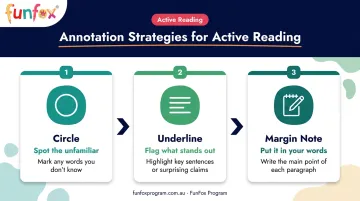
Encourage active annotation:
- Circle unfamiliar words
- Underline key sentences or surprising claims
- Write a one-word margin note after each paragraph — the main point in the student's own words
This keeps reading purposeful rather than passive, and the margin notes become useful when answering questions.
After Reading
Go through answers together — not just marking right or wrong. For each answer, ask: "Where in the text did you find that?" This is especially important for inference questions, where students need to build the habit of pointing to textual evidence rather than going on gut feeling.
When a student gets something wrong, the most valuable question is: "What made you think that?" This surfaces exactly where the reasoning broke down. Some common patterns to watch for:
- Confusing the author's view with a character's view
- Inferring meaning from one sentence without reading the surrounding context
- Relying on general knowledge instead of what the text actually says
Moving past wrong answers without examining them is a missed opportunity.
On frequency: short, spaced practice consistently outperforms one long sitting. Students who revisit reading skills in multiple brief sessions across the week retain more than those who cram the same total time into one go. Two to three sessions of 20–30 minutes each is enough to see steady progress — without turning worksheet practice into a source of dread.
What to Do When Worksheets Alone Are Not Enough
Some comprehension gaps run deeper than worksheet practice can address. Difficulty making inferences, weak vocabulary across subjects, or very low reading stamina are signs that a student needs more than independent exercises — they need guided instruction with real-time feedback.
Pair Worksheets with Independent Reading
Research consistently links reading volume with achievement. Moje's adolescent literacy review found that regular novel reading outside school related positively to academic grades. Worksheets develop skills; independent reading builds fluency, vocabulary, and background knowledge. Together, they give comprehension something solid to work with.
For Year 7 readers, the NSW Premier's Reading Challenge Years 7–9 booklist is a reliable starting point. Titles include Alex Rider graphic novels by Anthony Horowitz and 1918 by Libby Gleeson — accessible, engaging reads that still carry genuine literary weight. The CBCA's Older Readers category (ages 13–18) is also worth exploring, though maturity fit varies by title.
When Structured Support Becomes Important
Some signs point clearly to a need for structured support beyond worksheets:
- Falling noticeably behind grade-level expectations
- Losing confidence or becoming reluctant to read
- Consistently struggling with inference despite regular practice
In these cases, a structured small-group program provides what worksheets cannot: immediate feedback from a teacher who can identify why a student is reasoning incorrectly and adjust in the moment.
FunFox's Readers Club (Years 3–8) and High School Literacy Club (Years 7–10) offer live, teacher-led sessions in groups of no more than six students, aligned to the Australian curriculum. The small-group format means teachers get to know each student's specific gaps — not just mark answers, but address the reasoning behind them.
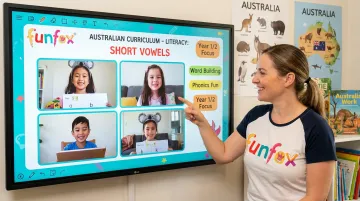
For Year 7 students moving into secondary school English, the High School Literacy Club's focus on advanced text analysis and structured response writing is a strong fit for this stage.
Frequently Asked Questions
What reading level should a Year 7 student be at?
Australian Year 7 students are assessed through NAPLAN's four proficiency levels: Exceeding, Strong, Developing, and Needs Additional Support. A "Strong" Year 7 reader can make inferences by connecting ideas across a text and interpret unfamiliar vocabulary from context. The closest external comparison is MetaMetrics' US Grade 7 text range of 970L–1120L, though this is not an Australian benchmark — significant variation is normal at this age.
How many comprehension worksheets should a Year 7 student do per week?
Two to three focused sessions per week is a practical starting point. Consistency matters more than volume: short, regular practice builds skills more effectively than occasional intensive sessions.
What skills do Year 7 reading comprehension worksheets focus on?
The five core skills are: making inferences, identifying main idea and supporting details, determining author's purpose and point of view, using vocabulary in context, and summarising. These are directly named in ACARA's Version 9 curriculum and reflected in NAPLAN Year 7 proficiency descriptors.
How do I know if my Year 7 child is struggling with reading comprehension?
Watch for these signs: difficulty explaining what a passage was about in their own words, skipping unfamiliar words without attempting their meaning, or consistently answering questions based on gut feeling rather than textual evidence. Inference questions are usually the first to reveal a genuine comprehension gap.
What types of texts are best for Year 7 comprehension practice?
A mix of all three — literary (stories, poetry), informational (articles, reports), and persuasive (opinion pieces, editorials). Students assessed in school face all three types, and a student who only practises with fiction will be underprepared for Science and Humanities comprehension tasks.
How can I help my child improve reading comprehension at home beyond worksheets?
Encourage regular independent reading in genres they enjoy, since volume matters. Discuss what they're reading: ask what the author was trying to do, what surprised them, what they'd argue against. If progress stalls, a structured live program with teacher feedback can help close persistent gaps.