Introduction
Picture this: you sit down to read your child's latest school story, and three sentences in, you notice something. Every line sounds the same. "The dog ran. The boy chased it. The dog hid." Short. Choppy. Repetitive. The ideas are there, but the writing feels flat.
This is one of the most common challenges primary school students face — not a lack of ideas, but a limited toolkit for expressing them. Sentence structure is that toolkit.
This guide covers what sentence structure actually is, the four types every primary student should know, the mistakes children make most often, and practical ways to help your child improve. Sentence structure is separate from spelling and vocabulary — a child can write impressive words and still produce confusing writing if the sentences themselves lack shape. The good news? It's a skill that can be taught, practised, and genuinely enjoyed.
Key Takeaways:
- Sentence structure governs how clearly and confidently a child communicates ideas in writing
- There are four sentence types: simple, compound, complex, and compound-complex
- NAPLAN writing assessments score sentence structure as its own separate criterion
- Common mistakes like fragments, run-ons, and repetitive patterns are all fixable with practice
- Sentence combining and wide reading are among the most effective ways to build structural awareness
What Is Sentence Structure?
Sentence structure refers to how the parts of a sentence — subject, verb, object, and other elements — are arranged to express a complete, clear thought. It governs not just grammatical correctness but also the flow and rhythm of writing, and how easy a piece is to read.
For primary school students, this matters enormously. Every writing task they're asked to do — a creative story, a persuasive letter, an information report — depends on their ability to construct sentences that make sense and hold together. Children who understand sentence structure write with greater confidence and express their ideas far more clearly.
The Building Blocks: Subject, Verb, Object
Every sentence has at minimum a subject (who or what it's about) and a verb (an action or state). Most also include an object (what receives the action).
Take this example: The dog chased the ball.
- Subject: The dog
- Verb: chased
- Object: the ball
Simple enough — but sentences get more complex once clauses come into play.
Independent vs. Dependent Clauses
A clause is a group of words containing a subject and verb. There are two types:
- Independent clause: A complete thought that stands alone. Example: The children laughed.
- Dependent clause: Has a subject and verb but cannot stand alone. Example: Because it was raining. (This needs more — it leaves the reader waiting.)
Conjunctions connect these clauses. Coordinating conjunctions (for, and, nor, but, or, yet, so — often remembered as FANBOYS) join clauses of equal weight. Subordinating conjunctions (because, although, since, when) introduce dependent clauses and show relationships like cause or time.
With these building blocks in place, it becomes much easier to understand how sentences grow in complexity — and how to teach that progression to young writers.
The 4 Types of Sentence Structure Explained
Skilled writers don't use just one type of sentence. They mix all four to create rhythm, emphasis, and variety. Primary school students who learn to do the same produce writing that's genuinely more engaging to read.
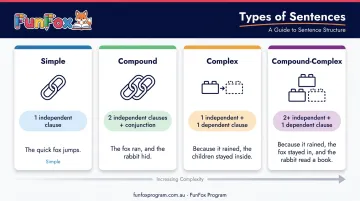
Simple Sentences
A simple sentence contains one independent clause — a subject and a verb, expressing one complete idea.
The fox ran fast.
Simple sentences are excellent for emphasis and clarity. The problem arises when a child uses only simple sentences: the writing begins to feel like a list rather than a flowing piece.
Even so, simple sentences can include objects and descriptive phrases without becoming complex: The old fox ran fast through the dark forest.
Compound Sentences
A compound sentence joins two independent clauses using a coordinating conjunction (FANBOYS) or a semicolon.
The fox ran fast, but the rabbit was faster.
This type helps children connect related ideas of equal importance. Note the punctuation: a comma before the conjunction is required when joining two full clauses. Compound sentences are introduced in the Australian Curriculum as early as Year 2, making them well within reach for most primary students.
Complex Sentences
A complex sentence pairs one independent clause with at least one dependent clause. This is where writing gains real depth: children can express cause, time, contrast, and condition.
Although it was raining, the children played outside.
Punctuation rule: when the dependent clause opens the sentence, use a comma after it. When it comes second, no comma is needed: The children played outside although it was raining.
Complex sentences allow students to show relationships between ideas rather than just listing them. That shift — from sequencing events to connecting them — is one of the clearest signs of growing writing maturity.
Compound-Complex Sentences
The most advanced type, a compound-complex sentence contains two or more independent clauses and at least one dependent clause.
Although it was raining, the children played outside, and their parents watched from the window.
Children should use this type sparingly, though. Overuse can produce tangled sentences that obscure meaning rather than clarify it.
Quick Reference: The 4 Sentence Types
| Type | Structure | Example |
|---|---|---|
| Simple | 1 independent clause | The fox ran fast. |
| Compound | 2 independent clauses + conjunction/semicolon | The fox ran fast, but the rabbit was faster. |
| Complex | 1 independent + 1 dependent clause | Although it was raining, the children played outside. |
| Compound-Complex | 2+ independent + 1+ dependent clause | Although it was raining, the children played outside, and their parents watched. |
Common Sentence Structure Mistakes Children Make
These are among the most frequently identified sentence-level problems in Australian educational resources and NAPLAN assessment descriptors.
Sentence Fragments
A fragment is an incomplete sentence — missing a subject, a verb, or both — punctuated as though it were complete.
Fragment: Running through the park. Fixed: She was running through the park.
Fragments often occur when children write down a thought mid-flow and don't notice it's incomplete. The NAPLAN persuasive writing marking guide scores a response as 0 for sentence structure when it contains fragments rather than complete sentences — a clear signal of how seriously this is assessed.
Run-On Sentences
Run-ons happen when two or more independent clauses are joined without proper punctuation or a conjunction.
Run-on: I went to the shops I bought a sandwich it was delicious.
Two fixes:
- Use a subordinating conjunction: I went to the shops, where I bought a delicious sandwich.
- Split into separate sentences: I went to the shops. I bought a sandwich. It was delicious.
NAPLAN guidance specifically flags run-ons with repeated conjunctions like "and" or "so" as unsuccessful writing — a pattern that comes up constantly in children's work.
Repetitive Sentence Structure
When every sentence in a paragraph starts the same way or follows the same length and pattern, writing becomes flat — even if the content is interesting.
Repetitive: The dog barked. The cat ran. The bird flew. The mouse hid.
Varied: The dog barked loudly. Startled, the cat bolted across the yard, while the bird took flight overhead.
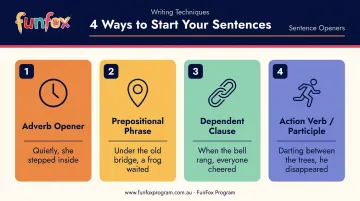
Encourage children to vary how sentences open. Some options to try:
- Adverb: Quietly, she stepped inside.
- Prepositional phrase: Under the old bridge, a frog waited.
- Dependent clause: When the bell rang, everyone cheered.
- Action verb: Darting between the trees, he disappeared.
Misplaced Modifiers
A misplaced modifier sits next to the wrong part of the sentence, creating unintended or confusing meaning.
Misplaced: Excited about the trip, the bags were packed by Mia. (This implies the bags were excited.)
Fixed: Excited about the trip, Mia packed the bags.
The rule is simple: the describing phrase must sit directly next to what it describes. A quick test is to ask, "Who or what is this phrase actually describing?" — if the answer isn't the word right after the comma, the modifier needs to move.
How to Help Your Child Improve Their Sentence Structure
Read Widely — and Read Aloud
Wide reading is one of the most effective foundations for strong writing. Research consistently shows a positive relationship between reading for pleasure and writing quality, particularly in narrative writing. When children read books with varied, well-crafted prose, they absorb different sentence structures naturally — without it feeling like study.
Choose books slightly beyond your child's usual comfort zone. When you read together, pause occasionally and notice how a sentence is constructed: "That's a long sentence — what's holding it together?"
Encourage your child to read their own writing aloud too. When a sentence runs on too long, sounds awkward, or loses its rhythm, children often catch the problem themselves when they hear it spoken. This builds self-editing skills alongside structural awareness.
Try Sentence-Combining Activities
Sentence combining is one of the most research-supported techniques for building structural awareness. The IES What Works Clearinghouse elementary writing guide recommends it as a practical strategy for improving meaning and style.
The method is simple: give your child two short sentences and ask them to combine them into one.
| Simple sentences | Combined version |
|---|---|
| The cat slept. It was raining. | The cat slept because it was raining. |
| The boy was tired. He finished his homework. | Although he was tired, the boy finished his homework. |
| Emma liked dogs. Her brother preferred cats. | Emma liked dogs, but her brother preferred cats. |
This works because it doesn't feel like grammar study. It feels like a puzzle.
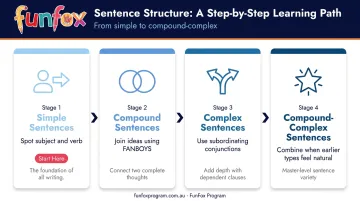
Introduce One Sentence Type at a Time
Rather than presenting all four types at once, build gradually:
- Simple sentences first: confirm your child can spot a subject and a verb before moving on
- Compound sentences next: practise joining two related ideas using FANBOYS (for, and, nor, but, or, yet, so)
- Complex sentences: experiment with subordinating conjunctions like because, although, when, and since
- Compound-complex sentences: introduce these once the earlier types feel comfortable and natural
Celebrate each milestone. That first well-formed complex sentence is a genuine leap forward — acknowledge it.
Consider Structured Writing Support
Occasional homework help is valuable, but consistent, guided practice is what builds lasting habits. For primary school students who need that regular structure, FunFox's Writers Club offers live, small-group online sessions (maximum six students) for Years 2–6, covering sentence variety and structure within an Australian Curriculum-aligned program.
The small class size means teachers can identify each child's specific sentence-level challenges and respond with targeted feedback — both during live sessions and through the Seesaw platform between classes.
Frequently Asked Questions
What are the 4 types of sentence structures?
The four types are simple (one independent clause), compound (two or more independent clauses joined by a conjunction or semicolon), complex (one independent clause plus a dependent clause), and compound-complex (two or more independent clauses plus at least one dependent clause). Strong writers use a mix of all four to create variety and rhythm.
What is the 2-3-1 rule in writing?
The 2-3-1 rule places the second-most important information at the start of a sentence, the least important in the middle, and the most important at the end — because readers naturally retain what they read last.
What is a sentence fragment, and why does it matter for children's writing?
A fragment is an incomplete sentence missing a subject, verb, or complete thought — for example, Running through the park. Addressing fragments early builds the habit of complete expression, a skill directly assessed in NAPLAN writing from Year 3 onwards.
At what age should children start learning about sentence structure?
Australian children typically begin with simple sentences in Foundation to Year 1, compound sentences in Year 2, and more complex structures through Years 3–6. By upper primary, the foundations for all four sentence types should be in place.
What is the difference between a simple and a compound sentence?
A simple sentence contains one independent clause: The bird sang. A compound sentence joins two independent clauses using a coordinating conjunction or semicolon: The bird sang, and the children listened. The key difference is whether one complete thought or two are present.
How can I tell if my child has good sentence structure in their writing?
Look for variety in sentence length and type, no run-ons or fragments, clear connections between ideas, and a natural rhythm when read aloud. A piece that meets those markers has strong structural foundations.