This happens more often than you'd think. The task sounds easy on the surface, but it actually asks students to make several decisions at once: What's worth mentioning? How should it start? Will it sound natural, or just like a list of facts stapled together?
Research on audience awareness in elementary writing shows that younger writers often default to "knowledge-telling" — retrieving whatever comes to mind first, rather than shaping information for a reader. That's not a flaw; it's just a skill that needs to be taught.
This guide walks through exactly what a strong self-description paragraph includes, how to write one step by step, and what to avoid along the way.
Key Takeaways
- A strong self-description includes your name, 2–3 key qualities, one specific detail, and a forward-facing closing line.
- Always identify your audience before writing — a classroom introduction reads very differently from a competition bio.
- Specific details beat vague ones every time: "I love writing adventure stories" beats "I enjoy writing."
- Avoid starting with "My name is..." — it's the most common opening and the least memorable.
- A simple four-part structure — who you are, what you do, one vivid detail, what you're working toward — keeps any self-description focused and on track.
What Should a Paragraph About Yourself Actually Include?
A self-description paragraph isn't a résumé. It should feel like a warm, brief introduction — not a checklist of facts.
The Core Ingredients
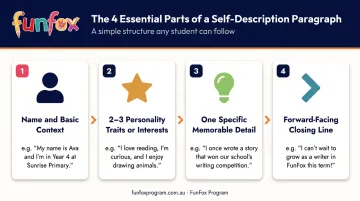
Every strong self-description paragraph needs:
- Name and basic context — your name, and if relevant, your age, year level, or location
- 2–3 personality traits or interests — the things that make you you, not just what you do
- One specific, memorable detail — a concrete example that shows rather than tells
- A forward-facing closing line — a goal, something you're working on, or what excites you right now
Show, Don't Tell
Vague labels tell the reader nothing. Specific details give them something to picture. Compare these:
| Vague | Specific |
|---|---|
| "I am creative." | "I spend my weekends building miniature cities out of cardboard." |
| "I enjoy sport." | "I've been learning to play football for three years and I'm finally getting my corner kicks right." |
The specific versions give the reader something real to picture — and something to remember.
How to Choose What to Include
A useful filter: ask yourself, "What would I want someone to know about me if they only had 30 seconds?" That single question makes it easy to cut — go deeper on 2–3 things that feel most like you rather than listing everything at once.
End with something forward-looking. A goal you're chasing, a project you're excited about, or even a question you love thinking about gives the paragraph momentum — and leaves the reader with a positive impression.
How to Write About Yourself in a Paragraph: Step by Step
Step 1: Brainstorm Before You Write
Before you touch the paragraph itself, jot down 5–10 things about yourself — hobbies, personality traits, a favourite subject, something you're proud of, a goal. Don't filter yet. Just write.
This removes the blank-page problem immediately. The IES practice guide for elementary writing recommends exactly this kind of structured prewriting — generating ideas before drafting — as one of the most effective steps in the writing process. With material already on the page, choosing what to keep becomes straightforward.
Step 2: Identify Your Audience and Purpose
Who is reading this paragraph, and why? That should shape everything — your tone, what details you include, even how formal you sound.
Three common contexts for primary school students:
- Classroom introduction — warm, friendly, age-appropriate
- School project or bio — slightly more structured, still personal
- Extracurricular or competition entry — more polished, lead with a relevant strength
The content might overlap, but the delivery changes. A fun fact that works perfectly in a class introduction might not belong in a writing competition bio.
Step 3: Choose Your Opening Line
"My name is..." is the most common opening — and the most forgettable. Starting with your name first tells the reader nothing interesting.
Weak opening: "My name is Lily and I like reading and drawing."
Stronger opening: "My favourite place in any house is the bookshelf — I've read every book on mine twice." Then, in the next sentence: "I'm Lily, and I'm in Year 4 at school."
Leading with something specific pulls the reader in. The name slots in naturally once you've already made them curious.
Step 4: Build the Middle With Specific Details
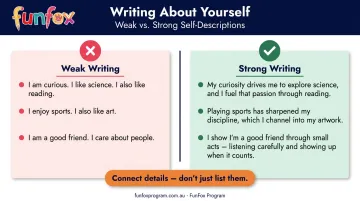
The body of your paragraph — roughly 2–4 sentences — is where you expand on 2–3 key things about yourself. The goal isn't to list everything; it's to connect details so they form a picture of a person. Linking a personality trait to an activity is more effective than listing them separately:
- ❌ "I am curious. I like science. I also like reading."
- ✅ "I'm the kind of person who has to know how everything works — which is probably why I'm obsessed with science documentaries and have a shelf full of nature books."
Step 5: Write a Closing Line That Sticks
The final sentence should leave the reader with something. A goal you're working toward, something you're currently excited about, or even a question you think about a lot — any of these gives the paragraph a sense of completion rather than just stopping mid-thought.
Example: "Right now, I'm trying to write my first short story — I've got the beginning and the ending figured out, just not the middle yet."
That kind of detail sticks — and it gives the reader something to ask about.
Adapting Your Paragraph for Different Situations
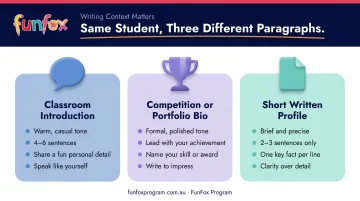
The same student writing for three different contexts should produce three different paragraphs — same core details, different tone and focus.
Classroom or school introduction: Keep it short (4–6 sentences), warm, and conversational. A fun or surprising detail helps spark conversation with classmates — this is the most relaxed format.
School competition or portfolio bio: Lead with a relevant strength or achievement rather than a general introduction. Slightly more formal tone — save the personal anecdotes for classroom contexts. Learning to shift writing voice across these formats is a core skill that FunFox's Writers Club builds directly, and it becomes increasingly valuable as school demands grow.
Short written profiles (school newsletter, online learning platform): 2–3 sentences maximum. Prioritise clarity. Pick one key fact that represents you well and leave the rest out — brevity is the goal here.
Common Mistakes to Avoid When Writing About Yourself
Trying to Include Everything
One of the biggest traps is cramming in too many details — school, sport, hobbies, family, goals — and ending up with a paragraph that reads like a list. Pick 2–3 things and go deeper, rather than touching 10 things briefly. A reader remembers specifics, not inventories.
Being Too Vague or Too Modest
Phrases like "I'm just a normal kid" or "I'm interested in a few things" don't give the reader anything to hold onto. You don't need to boast — but specific, confident language makes a far stronger impression than vague hedging. Even everyday interests become interesting when described with detail.
Forgetting Tone and Audience
Using the same paragraph everywhere is a shortcut that rarely serves the writer well. A paragraph written for a teacher needs a different register than one written for classmates — and getting it wrong is immediately obvious to anyone reading it.
Tone mismatches often look like this:
- Too casual for a formal context: Slang, abbreviations, or chatty phrasing in an assessment task
- Too stiff for a personal introduction: Formal language that sounds rehearsed rather than genuine
- Wrong level of detail: Sharing deeply personal information with a professional audience, or staying too surface-level with someone who expects depth
Example: What a Strong Self-Description Paragraph Looks Like
Here's a sample paragraph written from a primary school student's perspective:
If you ask my family what I'm always doing, they'll say the same thing: reading. I'm Priya, and I'm in Year 5. I love adventure stories — especially ones where the main character has to figure out a mystery with only a few clues — and I've been writing my own stories on weekends since Year 3. When I'm not reading or writing, I play chess at the school club on Thursdays, which has taught me to think three steps ahead before I make a move. Right now, I'm working on a story set in an underwater city, and I think it might be the best thing I've ever written.
A quick annotation:
- Sentence 1 — Strong, specific opening that avoids "My name is..." and immediately shows something about Priya's personality
- Sentence 2 — Name introduced naturally, with year level added as context rather than a standalone fact
- Sentence 3 — Specific interest with real detail (the type of story she loves)
- Sentence 4 — Second interest connected to a personality trait (thinking ahead)
- Sentence 5 — Forward-facing closing line that leaves the reader with something to remember
Notice that nothing here feels like a list of facts — each sentence does double duty, revealing both what Priya does and who she is.
Conclusion
A clear structure makes all the difference when writing about yourself. Know your audience, choose a few specific details over a long list of vague ones, and give your paragraph a real beginning, middle, and end.
This skill also extends well beyond a single assignment. Learning to choose what's relevant, organise it clearly, and write for a real reader — those habits carry students through every kind of writing they'll face at school and beyond.
FunFox's Writers Club is built around exactly this kind of foundational development, giving primary school students the skills and confidence to approach any writing task with genuine ease.
Frequently Asked Questions
How to write 150 words about yourself?
Follow the same structure — name, a few key qualities, specific interests, and a closing goal — but with a little more room. Aim for 4–6 solid sentences and expand one detail with a brief example. Don't pad to hit the word count; quality matters far more than reaching a number.
What are 5 good words to describe yourself?
Strong self-describing words are ones you can back up — think curious, determined, creative, caring, or enthusiastic. Choose adjectives tied to something real you do or care about, not ones that could apply to anyone.
What is an example of a short note about myself?
Here's one: "I'm Aiden, a Year 4 student who loves building things — from LEGO sets to code. My favourite thing I've ever made is a simple app that quizzes you on animal facts." Name, interest, and one specific detail, done in two sentences.
How do you start a paragraph about yourself?
Lead with something interesting — a favourite activity, a defining trait, or an unusual fact — before introducing your name. Starting with "My name is..." is the most common approach, and also the least memorable opening you can choose.
What should you avoid when writing about yourself?
Three main pitfalls: including too many details at once (which makes the paragraph feel like a checklist), using vague language that doesn't paint a picture, and forgetting to match the tone to your audience and context.
How do you make a self-description paragraph interesting?
Specific details are what make a paragraph memorable. Replace general statements with concrete examples — a particular book genre you love, a project you're currently working on, a place that matters to you. The more specific you get, the more the reader feels like they're actually meeting you.