Introduction
Many students sit down to write an assignment with perfectly good ideas — and still struggle. Not because they don't know the content, but because they haven't fully understood what type of writing they've been asked to produce.
This is a genre problem, and it's more common than most teachers realise.
From Year 1 through to Year 10 and beyond, students are expected to shift between very different kinds of writing — narratives, reports, persuasive essays, reflective accounts — each with its own rules, structure, and expectations. Yet many students (and parents) assume "academic writing" is one uniform thing.
It isn't. Misunderstanding this is one of the most preventable reasons students lose marks.
This guide covers what genre in academic writing actually means, the most common types Australian school students encounter from primary through to Year 10, and how to identify exactly what an assignment is asking for — before writing a single word.
Key Takeaways
- Genre in academic writing is a recognised category of text with its own purpose, structure, and conventions — not just a formatting choice.
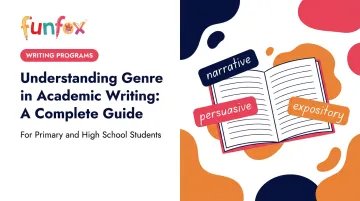
- The most common school genres include narratives, persuasive essays, reports, explanations, recounts, and analytical responses.
- All academic genres share core features: logical structure, appropriate tone, and clear purpose.
- Writing the wrong genre costs marks: NAPLAN awards 0 for text structure when a student submits an inappropriate genre type.
- Genre awareness builds from Year 1 onward, and starting early makes a measurable difference as school demands increase.
What Is Genre in Academic Writing?
Genre is simply a category of writing that follows a recognised set of conventions — including its purpose, structure, tone, and intended audience. Just as fiction has genres (mystery, fantasy, historical), academic writing has its own genre families.
The NSW Department of Education defines genre as a way of grouping different types of text according to similarities in form and function — and knowing the genre helps both readers and writers know what to expect.
Academic writing is not one single style. It is an umbrella term covering many distinct forms. Each form carries shared expectations about how it should be organised and what it should achieve — and understanding those expectations is what separates confident writers from confused ones.
Genre and Purpose Are Inseparable
Every academic genre exists to accomplish something specific:
- An essay argues a point
- A report documents findings from an investigation
- A reflective account analyses personal experience in relation to theory
- An explanation makes a process or concept clear to the reader
Choosing the right genre means understanding what the task is actually asking you to do — not just what topic to write about.
Why Genre Is Often Misunderstood
Many teachers and lecturers assume students already know the conventions of a given genre. In practice, this assumption is one of the biggest sources of confusion.
Students who've never been explicitly taught that a report looks different from an essay — or that "critically evaluate" signals something very different from "describe" — will default to whatever writing style feels most familiar.
Genre conventions also shift by discipline and year level. A science report looks different from a business report, and what's expected in Year 6 differs considerably from Year 12.
According to Australian genre-based pedagogy rooted in systemic functional linguistics, genres are goal-oriented, staged social processes — meaning their conventions reflect the values and practices of different academic communities. Students who grasp this write with purpose, not guesswork.
The Most Common Academic Writing Genres Explained
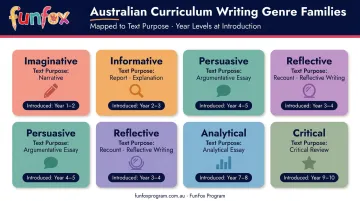
While there are many recognised academic genres, students across Australian primary and secondary schools are most regularly asked to produce a core group. The Australian Curriculum organises text purposes across six categories — imaginative, informative, persuasive, reflective, analytical, and critical — and the genres below map directly onto these. Here's how the most common ones break down.
Argumentative and Analytical Genres
Persuasive/Argumentative Writing
The most formally assessed writing type at school level. Students take a position and build a case using evidence, logical reasoning, and persuasive devices. NAPLAN assesses persuasive writing for students in Years 3, 5, 7, and 9 — structured around an introduction, developed argument, and conclusion.
Analytical Essay
Common from upper primary through to Year 10 and beyond. Similar to persuasive writing, but the focus shifts from convincing the reader to examining evidence and drawing reasoned conclusions. A strong analytical essay is built around a central argument, with each paragraph developing a distinct supporting point.
Critical Review or Critique
Designed to evaluate rather than summarise. The writer assesses the strengths, limitations, and significance of a text, study, or creative work. The key distinction: summarising retells what happened; critiquing makes and justifies a judgement about its quality or significance.
Informative and Research-Based Genres
Report
Organised under clear headings and sections, designed to present findings from an investigation in a structured, factual format. Reports prioritise clarity and logical organisation over argument — the writer presents evidence and draws conclusions rather than arguing a case upfront.
A science report and a business report share this basic structure, but their conventions differ by discipline.
Explanation
A genre focused on making a process, concept, or phenomenon clear. Common in primary school science and humanities tasks. Unlike a report, it doesn't document an investigation — it walks the reader through how or why something works.
Literature Review
More common from upper secondary onward, a literature review surveys and synthesises existing research on a topic, identifying themes, gaps, and debates. It's not a list of summaries — it requires the writer to show how different sources relate to each other.
Reflective and Narrative Genres
Narrative Writing
Time-ordered writing used to recount events and engage an audience emotionally. Its three-part structure — orientation, complication, resolution — is taught from early primary school and formally assessed through NAPLAN.
Recount and Reflective Writing
A recount retells events in sequence. Reflective writing goes further — it asks the writer to analyse their experience, connecting personal insight to broader understanding. Reflective tasks are more personal in voice and typically use first person, but they still require genuine analysis rather than simple description.
Key Features Shared Across Academic Writing Genres
Despite their differences, all academic writing genres share a common set of characteristics. Understanding these helps students approach any new genre with a solid starting point.
Formal, Objective Tone
Academic writing uses formal language — avoiding slang, contractions, and overly emotional phrasing — and maintains an objective stance, even when arguing a position. The language a student chooses signals their credibility. Phrases like "I reckon" or "it's really obvious that" undermine the authority of an otherwise well-reasoned argument.
Logical Structure and Coherence
Academic writing is not a collection of information dropped on the page. It must guide the reader through a clear line of thought. Ideas are sequenced purposefully, paragraphs are cohesive, and the reader always understands why they are being told what they're being told.
NAPLAN marking criteria capture this well: they assess text structure, ideas, vocabulary, cohesion, paragraphing, and sentence structure as separate, measurable dimensions of writing quality.
Evidence-Based Reasoning and Citation
Academic writing is grounded in evidence from credible sources, and that evidence must be properly attributed. Citation conventions vary — APA, Harvard, MLA — but the underlying principle is consistent across all genres: acknowledge where your ideas come from. In Australian schools, QCAA guidance makes clear that students are expected to reference direct quotes, paraphrasing, images, and electronic sources using their school's preferred referencing style.
Awareness of Audience and Purpose
The most effective academic writers ask two questions before they start writing: Who am I writing for? and What is this piece supposed to achieve? These questions shape decisions about structure, language, and depth. A report written for a science teacher has different expectations than a persuasive essay written for an English exam.
This awareness develops progressively with practice. FunFox's Writers Club builds it deliberately from Year 2 onward, helping students understand their audience and purpose before they write a single sentence.
How to Identify Which Genre Your Assignment Requires
Genre confusion at the start of a task creates structural problems that are difficult to fix later. Here's a practical approach to identifying what's being asked.
Step 1: Read the Instruction Verbs Carefully
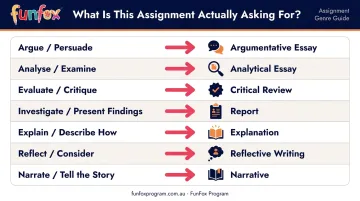
The verbs in an assignment brief are the most reliable genre signal. QCAA's Cognitive Verb Framework formally identifies these as the mental operations students are expected to perform — and they map directly to genre expectations:
| Instruction Verb | Genre Signal |
|---|---|
| Argue / Persuade | Argumentative essay |
| Analyse / Examine | Analytical essay |
| Evaluate / Critique | Critical review |
| Investigate / Present findings | Report |
| Explain / Describe how | Explanation |
| Reflect / Consider your experience | Reflective writing |
| Narrate / Tell the story | Narrative |
Step 2: Consider the Primary Purpose of the Task
Ask: is the goal to demonstrate knowledge, build an argument, document research, or reflect on experience? Each purpose maps to a different genre family. If an assignment says "conduct an experiment and present your findings," it points toward a report. If it says "write about a time when you faced a challenge," it points toward narrative or reflective writing.
Step 3: Ask When Still Unsure
If the genre is still unclear after working through Steps 1 and 2, ask the teacher directly. Most teachers prefer a quick clarifying question over a submission built on the wrong structure. Ask specifically: "Should this be set out as a report, or written as an essay?" That single question can save hours of rework.
What Happens When Genre Conventions Are Ignored
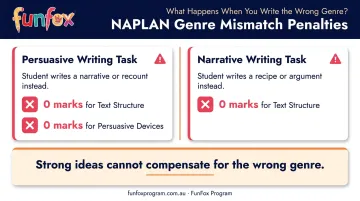
The consequences are direct and documented. The NAPLAN Persuasive Writing marking guide is explicit: if a student writes in an inappropriate genre — such as a narrative, description, or recount when a persuasive response is required — they receive 0 marks for text structure and 0 for persuasive devices. Strong ideas and fluent writing cannot compensate for producing the wrong type of text.
The same applies in the other direction: the NAPLAN Narrative Writing marking guide gives 0 for text structure if a student writes a recipe or argument instead of a narrative.
These penalties reflect a broader principle that extends well beyond formal assessment. Using informal language in a report, or failing to anchor an essay around a clear thesis, erodes the writing's credibility with any reader. Academic genres exist because readers in different fields have developed shared expectations — and writing that ignores those expectations signals unfamiliarity with the discipline.
The subtler cost is habitual. A student without genre awareness tends to write every assignment the same way, applying the same tone and structure whether the task calls for an argument, a report, or a personal narrative. Genre knowledge is what gives students the flexibility to read a task, recognise what's expected, and adjust their writing accordingly.
Frequently Asked Questions
What are genres in academic writing?
Genres in academic writing are recognised categories of text — such as persuasive essays, narratives, reports, explanations, and reflective accounts — each with its own purpose, structure, and conventions. Knowing the genre tells both writer and reader what to expect from the piece.
What are the 7 types of academic writing?
The most commonly cited types at school level are narrative, persuasive/argumentative, informative/report, explanation, recount/reflective, analytical/critical response, and procedure or methodology. Each serves a distinct purpose, and the exact list varies by year level and context.
What is the difference between an essay and a report?
An essay builds a continuous argument around a central thesis, written in flowing prose. A report presents findings from an investigation under organised headings and sections. The key difference: essays prioritise argumentation; reports prioritise structured, factual documentation of results.
How do I know which academic writing genre to use for an assignment?
Look closely at the instruction verbs in the task brief — words like "argue," "investigate," "reflect," and "evaluate" each signal a different genre. Consider the stated purpose of the task; if the genre still isn't clear, check with your teacher before you start.
At what age do children start learning academic writing genres?
Genre awareness begins in Year 1. The Australian Curriculum requires Year 1 students to create short imaginative, informative, and persuasive texts, and to explore how different purposes shape text structure. These early foundations directly support the more formal genre expectations of secondary school.
Why is it important to understand genre conventions?
Understanding genre conventions helps writers meet their audience's expectations, demonstrate the right skills for the task, and communicate clearly and credibly. As NAPLAN marking guides confirm, failing to write in the correct genre can cost marks even when content knowledge is strong.